

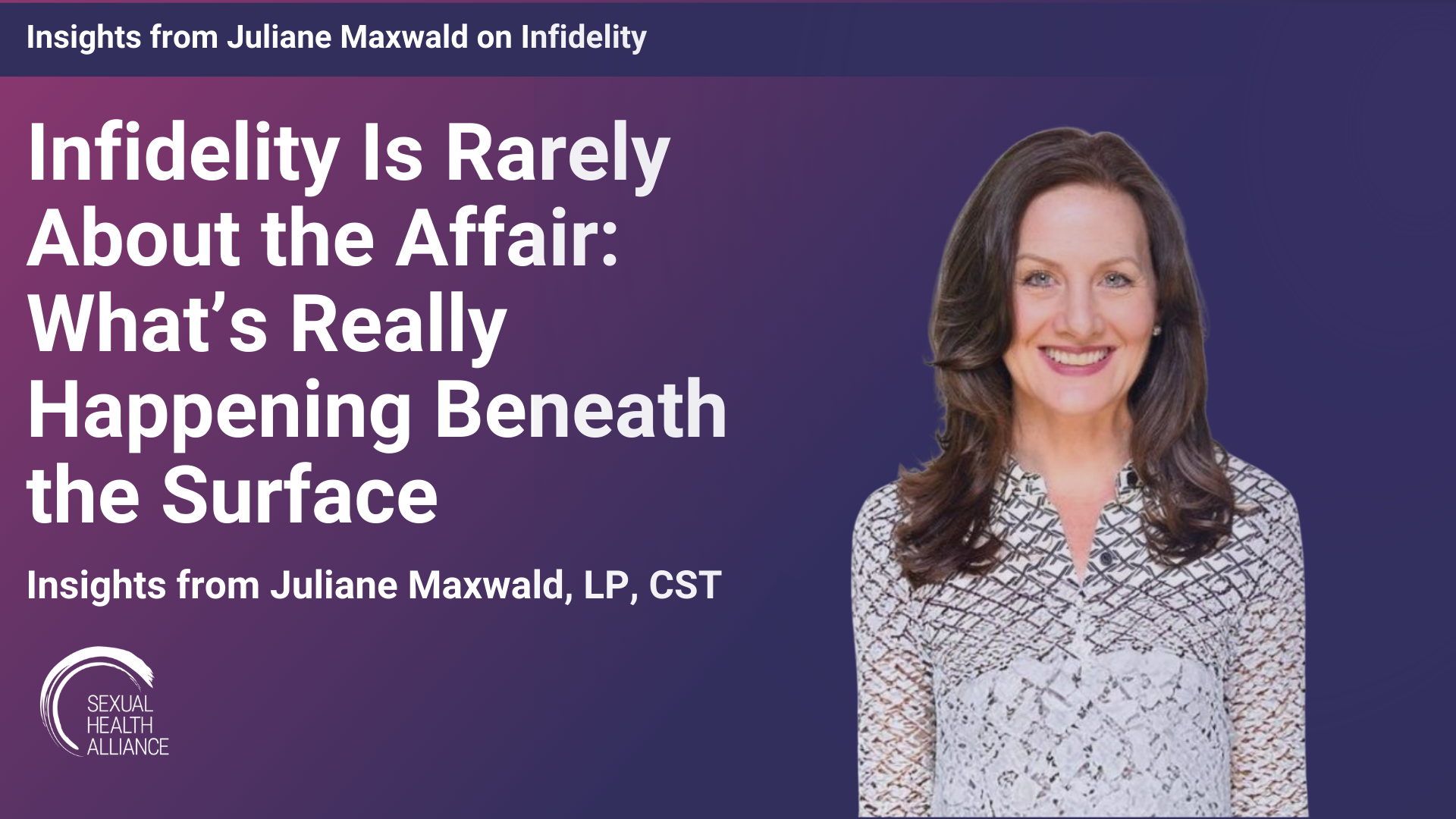
Insights from Juliane Maxwald, LP, CST
Infidelity is one of the most destabilizing experiences a relationship can face. For many people, it shatters trust, safety, and a sense of shared reality in an instant. The emotional aftermath is often intense—shock, anger, grief, confusion, and self-doubt can all surface at once. In the middle of that pain, the dominant cultural message is clear: If your partner cheats, that’s it. Trust is gone forever. End the relationship.
But according to licensed psychoanalyst and AASECT-certified sex therapist Juliane Maxwald, that narrative is not only incomplete—it can prevent people from accessing deeper healing and understanding.
In this interview with Sexual Health Alliance, Juliane offers a more nuanced, clinically grounded perspective on infidelity. One that does not excuse harmful behavior or remove accountability, but also does not reduce complex relational crises to simple moral failure. Her work invites individuals and couples to look “under the hood” of infidelity—where the real meaning, and the real opportunity for transformation, often live.
Why Infidelity Is So Hard to Understand
One of the reasons infidelity is so devastating is that it feels deeply personal. When someone steps outside a relationship, it’s easy—and often automatic—to assume:
I wasn’t enough.
They chose someone else over me.
This says everything about their character.
Juliane challenges this assumption directly.
She explains that infidelity is rarely about the third person or even the behavior itself. While that may feel counterintuitive, it is a consistent clinical observation. Affairs are not typically driven by the allure of a specific individual; rather, they emerge from a complex web of internal and relational dynamics that have often been unfolding for years.
This does not absolve the partner who was unfaithful from responsibility. Accountability still matters. But focusing exclusively on the act—or the person outside the relationship—can obscure what actually needs attention if healing is going to occur.
Looking “Under the Hood” of Infidelity
Juliane uses the metaphor of what’s happening “under the hood” to describe the psychological and relational processes beneath an affair. These can include:
unspoken needs or desires
long-standing emotional disconnection
unresolved conflict or resentment
identity shifts or developmental transitions
attachment wounds or trauma histories
avoidance of intimacy or vulnerability
Often, these issues are not consciously recognized by either partner until the crisis of infidelity brings everything to the surface.
From a therapeutic perspective, the affair itself is not the whole story. It is a symptom—a dramatic and painful one—but still a symptom of deeper dynamics that were already present.
Infidelity as Crisis—and Opportunity
There is no minimizing the fact that infidelity creates a crisis. Juliane is clear about this. Affairs are profoundly destabilizing, and the pain they cause is real and justified.
At the same time, she highlights something that can feel surprising in the midst of devastation: crisis can also create an opening.
When people are willing and supported to ask deeper questions—rather than rushing to judgment—infidelity can become a turning point. Questions such as:
Why did this happen now?
What was happening internally for the partner who stepped out?
What was happening in the relationship that went unaddressed?
What needs were not being spoken, seen, or understood?
These questions are not about blame. They are about meaning. And meaning is where healing begins.
Juliane’s clinical experience shows that when couples engage in this kind of exploration, the work can lead to deep transformation—whether the relationship ultimately continues or not.
The Myth of “Zero Tolerance”
A common cultural stance around infidelity is what Juliane describes as a zero tolerance approach: if someone cheats, the relationship is automatically over. Trust is irreparably broken. There is nothing to discuss.
While this response can feel empowering or protective, Juliane cautions that it often oversimplifies a very complex reality.
In her practice, she frequently sees people who come in quietly asking for something they feel almost ashamed to want: permission to stay.
They may still be angry and hurt. They may not know whether they should stay. But they want help understanding what happened and whether repair is possible.
Juliane emphasizes that these desires are not signs of weakness. They are signs of emotional honesty.
Wanting to Stay Is Not a Moral Failure
Many people assume that staying after infidelity means tolerating betrayal or excusing harm. Juliane reframes this entirely.
She explains that people who want to work on the relationship after an affair are often seeking:
understanding, not denial
accountability, not avoidance
healing, not erasure of pain
They want to know that what happened is not simply proof that their partner is irredeemably flawed. They want language for the complexity they are living inside.
This is especially important because infidelity is rarely the result of a single bad decision in an otherwise healthy system. It often reflects patterns that both partners have been living with—sometimes unknowingly—for a long time.
When Affairs Become an “Exit Strategy”
Juliane also names a difficult but clinically significant reality: sometimes affairs occur in relationships that were already deeply troubled or no longer viable.
In these cases, the affair may function—unconsciously—as an exit strategy.
This does not make the affair healthy, fair, or productive. But it does suggest that the relationship itself may have been struggling to end in more direct or communicative ways.
Understanding this context can help individuals avoid reducing the entire history of a relationship to the moment of betrayal. It can also support clearer decision-making about whether repair or separation is the healthiest path forward.
Accountability Without Moral Condemnation
A critical part of Juliane’s perspective is that understanding is not the same as excusing.
The partner who engaged in infidelity must still take responsibility for their choices. Repair cannot happen without accountability, transparency, and sustained effort.
However, accountability rooted in curiosity and compassion is far more effective than accountability rooted solely in shame.
When people are able to explore the “why” of infidelity, they are more likely to:
take meaningful responsibility
understand their own patterns
make different choices in the future
engage honestly in repair
Moral condemnation may feel satisfying in the short term, but it often shuts down the very conversations that make change possible.
Why This Perspective Matters for Healing
Juliane’s approach offers a powerful alternative to the dominant narrative around infidelity. Instead of asking only, “Can I ever trust them again?”, she invites people to also ask:
What was happening that neither of us could say out loud?
What does this crisis reveal about us individually and together?
What kind of relationship do we want to build from here—together or apart?
These questions move people out of binary thinking and into reflective, intentional decision-making.
For some couples, this process leads to reconciliation and a relationship that is more honest and connected than before. For others, it leads to a thoughtful, compassionate separation rather than a reactive one.
In both cases, the goal is not to “save” the relationship at all costs—but to support psychological and relational integrity.
Implications for Therapists and Clinicians
For sexual health professionals, sex therapists, and sexuality counselors, Juliane’s insights carry important implications:
Infidelity should be approached as a complex relational phenomenon, not just a behavioral violation.
Clients often need explicit permission to explore repair without shame.
Zero-tolerance frameworks can prematurely foreclose healing options.
Deep work requires attending to individual psychology and relationship dynamics.
Clinicians who can hold this complexity help clients move beyond reactivity and into meaningful healing—regardless of the outcome.
Summary: Understanding Infidelity
Licensed psychoanalyst and AASECT-certified sex therapist Juliane Maxwald explains that infidelity is rarely about the affair partner or the behavior itself. Instead, it reflects complex underlying dynamics within the individual and the relationship. While infidelity creates a destabilizing crisis, it can also present an opportunity for deep understanding and transformation. Many people seek permission to work on relationships after infidelity rather than ending them immediately. A zero-tolerance approach may overlook important nuances and limit healing. Meaningful repair requires accountability, exploration of root causes, and compassionate, informed support.
Final Takeaway
Infidelity is painful. There is no shortcut around that truth.
But reducing it to a single moral verdict often prevents people from accessing the deeper understanding that healing requires. As Juliane Maxwald reminds us, when we are willing to look beneath the surface—without excusing harm or rushing to judgment—we create space for clarity, repair, and transformation.
Whether a relationship continues or ends, the work of understanding infidelity can be profoundly healing. And for many people, that work begins with permission: permission to ask why, permission to stay curious, and permission to choose a path that reflects their values rather than cultural reflexes.
Want to become an in-demand sexual health professional? Learn more about becoming certified with SHA!

