
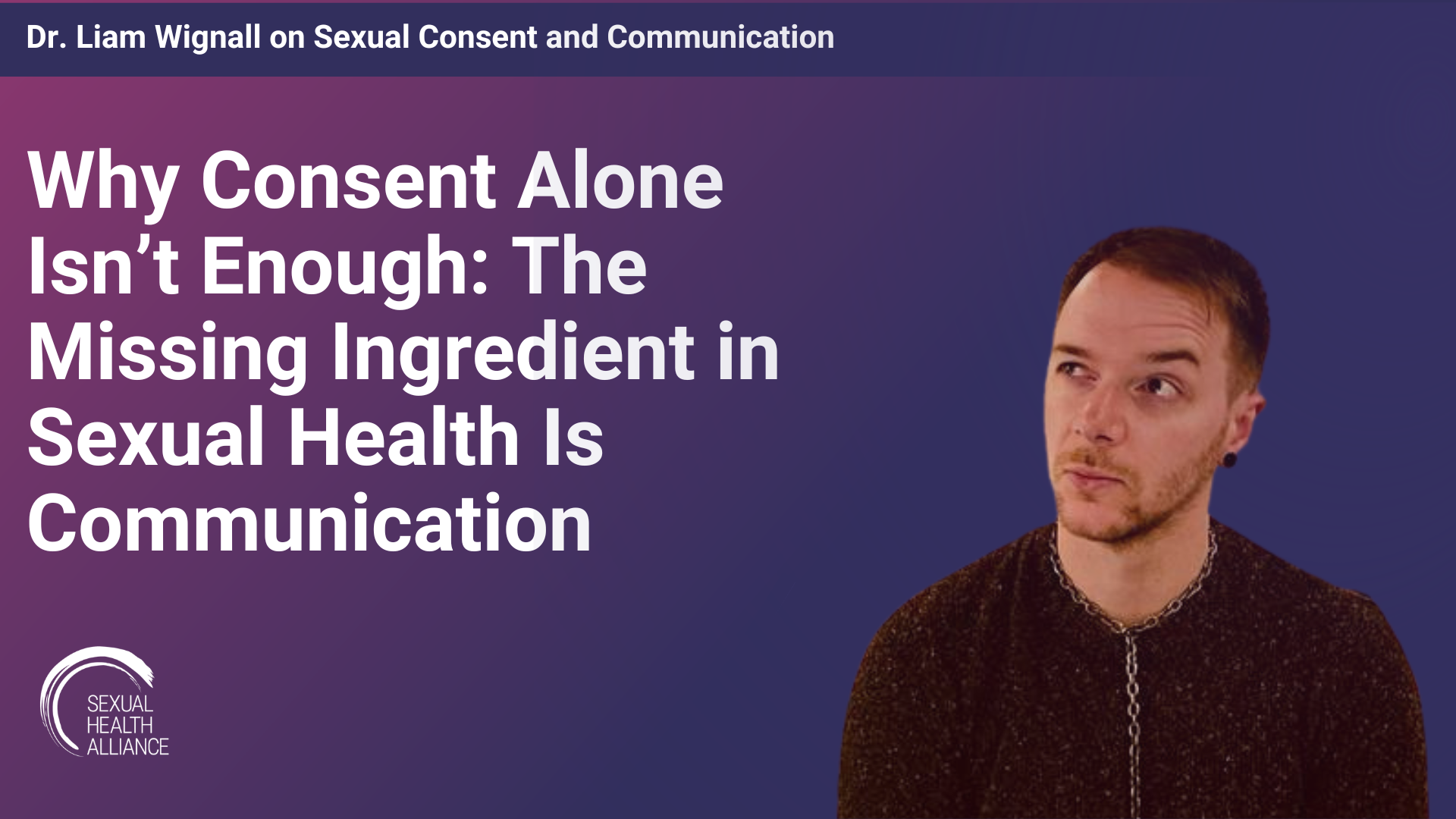
What Dr. Liam Wignall Teaches Us About Sex, Subcultures, and Talking Better
Consent is often described as the cornerstone of sexual health. It’s taught, promoted, and emphasized across education, activism, and clinical work—and for good reason. Consent matters.
But according to sexual health researcher Dr. Liam Wignall, consent is not where the work ends. In fact, if we stop there, we miss the factor that most consistently shapes sexual well-being across relationships, communities, and healthcare systems: communication.
In this interview, Dr. Wignall challenges a widely held assumption—that communities doing “consent right” are therefore doing sexual health right. Drawing from research, subcultural studies, and real-world examples, he argues that it’s not consent alone that improves outcomes. It’s what happens before, during, and after sexual encounters—and how people stay in communication even when things feel awkward, imperfect, or unfinished.
This blog unpacks Dr. Wignall’s core insight: why communication is the variable that truly “moves the needle” in sexual health, and what happens when silence, stigma, or avoidance take its place.
The Limits of Consent as a Standalone Concept
Dr. Wignall begins by naming something that can feel counterintuitive, especially in sex-positive and consent-focused spaces:
We like to think that consent is the key thing the community does so well. And I argue it’s not.
This is not an argument against consent. It’s an argument against treating consent as sufficient.
Consent is often framed as a moment—something that is obtained, confirmed, or checked. Communication, by contrast, is a process. It’s ongoing, contextual, and relational. And when researchers examine what actually impacts sexual health outcomes across studies and settings, communication repeatedly emerges as the critical factor.
Communication Is Already Happening—We Just Don’t Always Name It
One of Dr. Wignall’s most important observations comes from his work studying sexual subcultures.
In many of these spaces, people don’t explicitly say the word “consent.” Yet when he interviews participants about how they navigate sex with different partners, they describe a rich web of communicative practices:
chatting beforehand
checking in during encounters
debriefing afterward
paying attention to body language
developing safe words
negotiating expectations informally
None of this may be labeled as “consent” in a formal sense—but all of it falls squarely under communication.
Dr. Wignall’s point is not that consent doesn’t matter. It’s that communication is the mechanism through which consent becomes meaningful, adaptive, and protective.
Why Communication Has a Bigger Impact on Outcomes
When Dr. Wignall prepared a talk on well-being for an online course in the UK, he examined research across multiple contexts and populations. He asked a version of the same question posed in this interview: what actually makes the biggest difference?
Again and again, the answer was communication.
Communication affects:
sexual satisfaction
emotional safety
physical health outcomes
ability to navigate boundaries
capacity to repair when things don’t go well
Consent might open the door. Communication determines what happens inside.
The “Block and Forget” Culture—and Why It’s a Sexual Health Problem
Dr. Wignall offers a concrete example from men who have sex with men (MSM) communities.
There’s a common, informal rule: if you hook up with someone and the experience isn’t good, you block them. The encounter disappears. No follow-up. No conversation. No awkwardness.
From an emotional avoidance perspective, this makes sense. But from a sexual health perspective, Dr. Wignall argues it’s deeply problematic.
When communication ends immediately after sex:
there’s no way to discuss symptoms
no way to follow up about potential exposure
no way to clarify timelines or risks
During the COVID-19 pandemic, this became especially visible. People began sending brief messages after hookups—not necessarily to deepen connection, but to keep a communication channel open in case symptoms emerged.
That shift revealed something important: post-sex communication is a health intervention.
Awkward Conversations Are Still Protective Conversations
Dr. Wignall notes that this shift didn’t stop with COVID. In some cases, it evolved into practices like:
waiting a few months before blocking
sending a brief “that wasn’t great, but let’s keep contact open” message
tolerating short-term awkwardness for long-term health
These are not romantic gestures. They are practical, preventive ones.
Sexual health is not just about what happens during sex. It’s about what people can talk about after sex—especially when the experience wasn’t ideal.
Avoidance may feel easier, but silence carries risk.
Communication Failures in Healthcare: When Stigma Blocks Care
Dr. Wignall extends this argument into healthcare settings, where communication gaps can have serious consequences.
People who engage in BDSM, for example, often anticipate judgment from sexual health providers. As a result, they may withhold information about consensual practices.
Dr. Wignall describes cases where:
patients presented with bruises from consensual impact play
lack of communication led providers to misinterpret injuries
individuals were reported or treated inappropriately
This is an extreme example—but it illustrates a broader issue. When communication breaks down between patients and providers, care quality suffers.
Without open dialogue:
tests may be inappropriate
advice may not apply
recommendations may be inaccurate or harmful
In these contexts, communication is not a soft skill. It’s a clinical necessity.
Stigma Silences People—and Silence Harms Health
A recurring theme in Dr. Wignall’s work is how stigma interferes with communication.
When people expect judgment—whether about:
sexual practices
number of partners
relationship structure
kink or BDSM
—they are less likely to disclose relevant information. That lack of disclosure doesn’t protect them. It increases risk.
Good sexual health services depend on environments where people can speak honestly without fear of moral evaluation.
Consent vs. Communication: A False Choice
Dr. Wignall is not arguing for replacing consent with communication. He’s arguing for expanding the frame.
Consent is essential—but it’s static if not supported by communication.
Communication is dynamic—but it needs ethical grounding.
Together, they create sexual health. Separately, they fall short.
What This Means for Sexual Health Professionals
For sex therapists, educators, and clinicians, Dr. Wignall’s insights translate into concrete practice shifts:
Teach Communication, Not Just Consent
Consent education that doesn’t include skills for talking before and after sex is incomplete.
Normalize Post-Sex Conversations
Checking in after sex—about pleasure, feelings, or health—is not excessive. It’s protective.
Reduce Stigma to Improve Disclosure
Clients and patients talk more when they feel safe. Safety improves outcomes.
Treat Awkwardness as a Feature, Not a Failure
Many necessary sexual health conversations feel uncomfortable. That doesn’t make them wrong.
Communication as the Throughline of Sexual Well-Being
Dr. Wignall’s work reminds us that sexual health isn’t built on a single moment of agreement. It’s built on ongoing dialogue—between partners, between communities, and between patients and providers.
When communication is prioritized:
consent becomes clearer
risk becomes manageable
pleasure becomes negotiable
care becomes appropriate
When communication is avoided, even well-intentioned systems fail.
Summary: Communication and Sexual Health
Sexual health researcher Dr. Liam Wignall argues that consent alone is not sufficient for healthy sexual outcomes. Research across communities and healthcare settings shows that communication—before, during, and after sexual encounters—is the key factor influencing well-being. Practices such as post-sex check-ins, maintaining communication channels after casual encounters, and open dialogue in healthcare settings help reduce risk and stigma. When communication breaks down due to avoidance or judgment, sexual health outcomes worsen. Prioritizing communication alongside consent improves safety, care quality, and sexual well-being.
Final Takeaway
Consent matters. But it’s not the finish line.
Dr. Liam Wignall challenges us to look at what actually keeps people safe, connected, and supported over time. Again and again, the answer is communication—messy, ongoing, sometimes awkward communication.
Sexual health doesn’t improve when conversations end at “yes.”
It improves when conversations continue.
Want to become an in-demand sexual health professional? Learn more about becoming certified with SHA!

