


Guest post for Sexual Health Alliance by Vanessa Cushing M.S, LPC, NCC, CST
You cannot build a thriving sex therapy practice by separating great therapy from great business. A sustainable (and profitable) practice requires both. The practitioners who build practices that last are the ones who get certified, define a narrow niche, design an offer clients cannot say no to, and use marketing channels that actually work in this field. This article covers all of it: from licensure to the business frameworks that grow a sustainable practice. As a gift to the readers I will also tell you what I have found works and what does not in marketing sex therapy to save you a lot of time and a lot more money.
My name is Vanessa Cushing M.S, LPC, NCC, CST I am the Owner of Cushing Counseling located in Virginia, DC, Maryland, and Florida. I am an AASECT Certified Sex Therapist, Johns Hopkins trained therapist, entrepreneur, and a dog mom. Cushing Counseling has been in business for 4 years and I have taken the practice from a solo private practice to a group practice that now receives 60+ consultations every month. When I started I had the same amount of resources and knowledge as you (maybe less) . I didn't go to business school. I figured this all out on my own, and my gift to you is all the lessons I have learned so maybe you can save time, make more money, and more importantly help more people.
The Clinical Foundation You Need to Build a Sex Therapy Practice
Before you can build a sex therapy practice, you need the credentials that give you legal standing to do the work and the specialized training that makes you actually good at it. These are not the same thing.
Licensure: The Non-Negotiable Starting Point
Sex therapy is not a standalone licensed profession in most U.S. states. To practice, you first need an independent clinical license in psychology, social work, professional counseling, marriage and family therapy, or medicine, a master's degree at minimum, supervised clinical hours, and passage of your state's licensing exam.
AASECT Certification: The Gold Standard to Build a Sex Therapy Practice
The American Association of Sexuality Educators, Counselors and Therapists (AASECT) offers the most widely recognized certification for sex therapists in the U.S. Here is what the path requires:
A minimum of 90 hours of coursework across 15 core areas of human sexuality
At least 60 hours of sex therapy-specific training, with 30 hours required in-person
A minimum of 50 hours of clinical supervision with an AASECT Certified Supervisor (25 hours if you have 10+ years of practice)
Active AASECT membership and adherence to the professional code of ethics
Organizations like the Sexual Health Alliance offer AASECT-approved training online and self-paced, making the path more accessible than ever.
Two Very Different Paths: Solo Practice vs. Group Practice
Not all sex therapy practices are built the same. A solo practice and a group practice are fundamentally different business models, different financial structures, different management demands, and different income ceilings. Choosing the right model for where you are in your career is one of the most consequential decisions you will make when you build a sex therapy practice.
The Solo Sex Therapy Practice
A solo practice means you are the clinician, the business owner, and often the administrator. The advantages are simplicity and autonomy: you set your hours, control your caseload, and keep nearly all revenue after overhead. The trade-off is that your income is directly tied to your hours billed.
A solo practice makes sense if you are early in building your niche, want to test your offer and pricing before scaling, or prefer deep one-on-one work without the operational complexity of managing others.
Income ceiling reality: A fully booked solo sex therapist at $200/session with 20 weekly clients generates roughly $200,000 in annual gross revenue. After overhead, taxes, and unpaid administrative time, take-home is typically $120,000–$150,000 the realistic ceiling without additional revenue streams. Getting to 20 clients a week at $200 is the harder part.
The Group Sex Therapy Practice
A group practice introduces associate or independent contractor therapists under one umbrella. As practice owner, you shift from primarily doing clinical work to building systems, supervising clinicians, and generating enough client volume to keep a team busy. The income ceiling rises significantly but so does the complexity (trust me).
A group practice becomes viable when your own caseload is consistently full with a waitlist, when you have the systems and infrastructure to support other clinicians, and when you are willing to shift part of your identity from clinician to business owner.
If you are considering a group practice, here are the critical factors to evaluate before adding your first associate:
Your solo caseload is consistently full with a waitlist
You have reliable referral volume that can support multiple clinicians
You have (or can build) operational systems: EHR, billing, onboarding, compliance
You are willing and qualified to provide or coordinate clinical supervision
You have financial runway to cover 3–6 months of associate ramp-up before billings cover their cost
Your brand, niche, and marketing are strong enough to feed more than one full caseload
You have a proven marketing channel that works - consistently.
The biggest mistake practice owners make is adding clinicians before demand, systems, or financial runway are in place. This is a recipe for disaster for both your reputation and your clinicians. Grow the infrastructure first; add the people second.
The Map: A Framework for Building a 7-Figure Sex Therapy Practice
Most therapists learn everything about clinical practice and almost nothing about how to run a business. The Map changes that. It is a framework for thinking about every lever in your practice, not just the clinical work, but the systems that let that work reach more people and generate sustainable income. This is more for individuals that would like to start a group practice.
The goal at the center is specific: a 7-figure sex therapy practice (the dream!). That requires all three pillars of the framework working together. The client lifetime value (LTV) in a well-run sex therapy practice runs approximately $700, which means understanding how many clients you need, how long they stay, and what you charge is the foundation of every growth decision you make. Many clinicians and group practice owners don’t even know what LTV is so you reading this is already putting you ahead of 90% of clinicians.
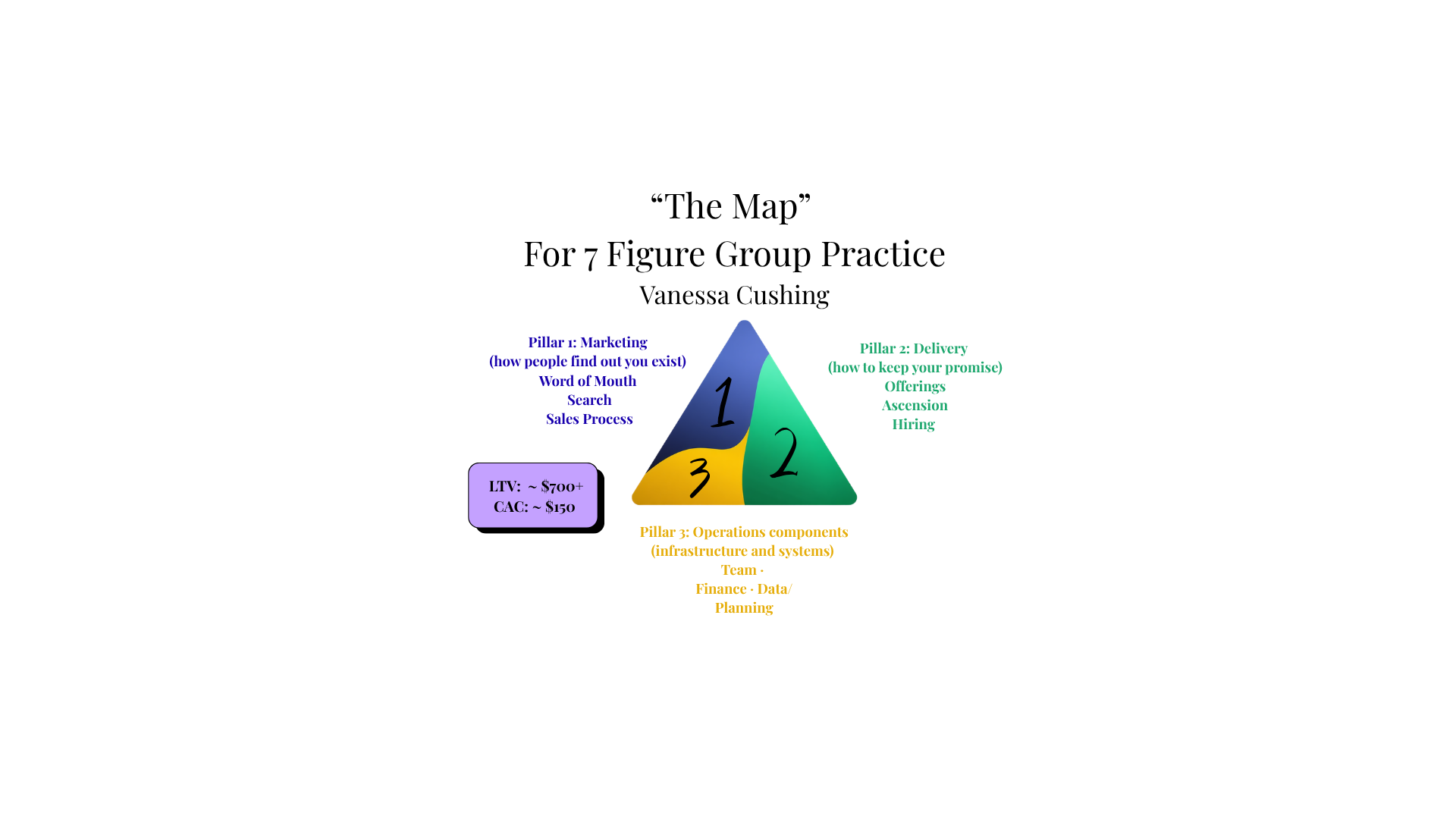
The Map - Vanessa Cushing Owner of Cushing Counseling
Pillar One: Marketing
🔵 Marketing channels: Sales Process · Word of Mouth · Search
Marketing is how prospective clients find you and decide to reach out. The Map identifies three primary channels. The sales process is what happens between first contact and a booked appointment, a deliberate intake structure and a clear offer dramatically improve conversion. Word of mouth compounds over time through exceptional outcomes and strong referral relationships. Search both organic SEO and paid search is how clients who do not know you find you when they are actively looking.
Pillar Two: Delivery
🟡 Delivery components: Offerings · Ascension · Hiring
Delivery is how you fulfill on your promise to clients. Offerings are your specific services and packages — the more clearly defined and deliberately priced, the easier it is to communicate value. Ascension is the deliberate movement of clients up your value ladder, increasing LTV while serving them more comprehensively. Hiring is the mechanism by which a group practice scales delivery beyond the founder's individual capacity.
Pillar Three: Operations
🟢 Operations components: Team · Finance · Data/Planning
Operations is the infrastructure that allows Marketing and Delivery to function reliably. Team means the administrative and operational support that frees clinical time for clinical work. Finance means knowing your numbers: revenue per clinician, overhead ratios, cost per acquired client relative to their $700 LTV. Data and planning means tracking what is actually working and making decisions based on evidence rather than intuition.
Why LTV matters: With a client LTV of approximately $700, you can calculate exactly how much you can afford to spend acquiring a new client, how many new clients you need each month to hit your revenue targets, and where to invest in retention and ascension to grow that number over time. This turns vague growth goals into specific, measurable decisions.
How to Build a Sex Therapy Practice That Attracts the Right Clients
Niche Down to Stand Out
Alex Hormozi's foundational principle from $100M Offers is direct: the riches are in the niches. Sex therapy is already a specialty, but it is a broad one. Narrow further couples recovering from infidelity, sexual dysfunction tied to chronic illness, LGBTQ+ affirming care, religious and purity culture recovery. Each represents a specific person with a specific painful problem. When your content speaks directly to that person's experience, they feel seen, and they book.
Design a Grand Slam Offer to Build a Sex Therapy Practice That Converts
Hormozi's Value Equation reframes how to package your services: Value = (Dream Outcome × Likelihood of Achievement) ÷ (Time Delay × Effort). Package your work around the transformation clients want - restored intimacy, relief from shame, a fulfilling sex life - not the mechanism.
Instead of: “12-session individual therapy package”
Try: “A 90-Day Intimacy Reset for couples ready to rebuild physical and emotional connection - structured sessions, between-session exercises, and direct messaging support included”
Pricing Strategy: The 35% Rule for Your Sex Therapy Practice
One of the most practical pricing frameworks for building a sex therapy practice: your price is calibrated correctly when roughly 35% of the people you offer it to say yes.
If more than 35% of prospective clients are converting, raise your price. You are undercharging for the value you deliver. If fewer than 35% are converting, lower your price or improve your offer clarity. Track your consult conversion rate consistently and let the data drive pricing decisions instead of guesswork.
According to Blueprint, private pay therapy in the U.S. ranges from $100 to $250+ per session, with specialization commanding the higher end. Sex therapy's relative scarcity means you have room to price toward the premium range, let the 35% rule confirm it.
How to Help Clients Afford Sex Therapy: Thrizer and Out-of-Network Benefits
One of the most common barriers to booking sex therapy is cost. Even clients who genuinely want help will hesitate when they see an out-of-pocket rate of $175–$250 per session. Thrizer removes that barrier and it does so in a way that positions your practice as a partner in making care accessible, not just a provider sending a bill.
What Thrizer Is and How It Works
Thrizer is a service that submits out-of-network insurance claims on behalf of your clients. Rather than requiring clients to navigate the superbill process themselves which many never do because it is confusing and time-consuming, Thrizer handles the submission automatically. Clients receive their out-of-network reimbursement without the administrative friction that typically prevents them from claiming benefits they have already paid for.
For clients with PPO plans, out-of-network reimbursement typically covers 40–80% of the session fee after deductibles are met. That means a $200 session can effectively cost a client $40–$120 out of pocket once reimbursement comes through a number that makes sex therapy financially accessible to a much larger pool of people.
How to Position Thrizer as a Client Acquisition Tool
The key positioning move is to frame Thrizer as something your practice provides for your clients, not something they have to figure out on their own. Your practice covers the cost of the Thrizer service on the back end. What clients experience is a practice that actively helps them use their insurance benefits, removes the paperwork burden, and makes it as easy as possible to access care. (I am not sponsored by Thrizer!)
Positioning language: We want care to be as accessible as possible for you. Our practice uses Thrizer to submit your out-of-network insurance claims on your behalf at no cost to you. Many clients with PPO plans receive 40–80% reimbursement on their sessions, and we handle all the paperwork so you don't have to.
This framing accomplishes several things at once. It differentiates your practice from competitors who either do not accept insurance at all or leave clients to manage superbills alone. It reduces sticker shock by giving prospective clients a clear picture of their effective out-of-pocket cost. And it demonstrates that your practice is invested in their experience beyond the clinical hour which builds trust before the first session even begins.
The Client Acquisition Impact
When cost is the primary reason a prospective client hesitates to book, removing that barrier directly affects conversion. A consultation call that ends with “I need to think about whether I can afford it” becomes much more likely to convert when the therapist can say: “Many clients with PPO plans end up paying $40–$80 per session after Thrizer submits their claims and we take care of all of that for you.”
In practice, proactively communicating Thrizer as part of your intake process on your website, in your consultation call, and in your welcome materials signals that your practice is different, client-centered, and committed to making quality care genuinely accessible.
The Hormozi Core Four: Marketing Your Sex Therapy Practice
Alex Hormozi's Core Four framework identifies the only four ways any business acquires clients. Every marketing channel fits into one of these four categories. Understanding this prevents you from chasing tactics and helps you invest energy where it actually moves the needle.
1. Warm Outreach - The Fastest Way to Build a Sex Therapy Practice Referral Base
Warm outreach means reaching out to people who already know you. For a sex therapist, this most often looks like direct conversations with OBGYNs, urologists, pelvic floor physical therapists, primary care physicians, and couples therapists who do not specialize in sexual health. A personal introduction, a phone call, a lunch, or a referral letter builds relationships that fill a calendar faster than any digital campaign. This is an ongoing habit, not a one-time event.
TIP: Focus on creating relationships + friendships. People can feel when you have a hidden agenda do NOT ask for referrals. Just provide value and connect if they like you they will automatically think of you.
2. Cold Outreach - Expanding Beyond Your Network
Cold outreach is reaching out to potential referral sources who do not know you yet. Lead with what you can offer their patients not a request for referrals. A brief introduction to your specialty and who you serve is far more effective than a generic networking ask.
3. Content - The Long Game That Compounds
Content is anything you create and publish: blog posts, videos, podcast appearances, social media, directory profiles. Unlike outreach, content works while you sleep. For a sex therapy practice, content builds trust with prospective clients navigating shame before they are ready to reach out, and signals expertise to referral sources vetting you before they send a patient your way. It is important to note that content is more of a lead nurture mechanism rather than an acquisition channel.
4. Paid Advertising - The Accelerant (When Used Right)
Paid ads are the only Core Four channel that scales with budget. They can accelerate what is already working, but they will not rescue a weak offer or unclear niche. The right paid channel matters enormously for sex therapists which leads directly to what actually works and what does not.
Here's What Has Actually Worked And What Has Not to Build my Sex Therapy Practice
Theory is useful. First-hand experience is more useful. Here is an honest account of what has moved the needle and what has been a waste of time and money across multiple specializations.
What Works: Google Business Profile and Reviews
A fully optimized Google Business Profile is one of the highest-return, lowest-cost investments available to a private practice. When someone in your area searches for a sex therapist, a verified GBP with recent reviews positions you prominently in the local map pack - often above organic results.
We are not allowed as therapists to ask clients for reviews so what do we do? Well I will leave reviews on colleagues GBP and most of the time they will write one back! Remember when I talked about providing value to people and then they will give back? This is a great example of that.
Practical tip: Reviews mentioning your specialty in general terms (“intimacy issues,” “relationship challenges”) help your profile surface for niche search terms. Remind clients that specific, genuine reviews help others who are searching for similar support find you.
What Works: SEO
Organic SEO has been one of the most reliable client acquisition channels for a sex therapy practice. The niche has relatively low online competition - Abundance Practice Building confirms this - which means consistent content around specific, searchable topics produces outsized ranking results compared to more crowded therapy categories.
What Works: Google Ads
Google Ads have worked where Meta advertising has not. The reason is intent: someone typing “sex therapist near me” into Google is already problem-aware and solution-seeking. You are meeting them at the moment of decision. When the ad pairs with a specific, well-matched landing page and a clear offer, the conversion rate justifies the spend. I was almost hesitant in writing this because Google Ads have been my primary driver of growth. If your Google Ads work and the mechanisms are technically configured right get ready for the consults to come in. Google actually lets you see who is bidding against you and it is all the big players: Better Help, Grow Therapy (yuck!) but no small local business!! Use what you have and they don’t - “Small Local Business” “Your name won’t get lost here” or “You are a human to us and not a number like other massive companies”. See how the positioning is different?
What Has NOT Worked: Meta Ads
Meta advertising Facebook and Instagram ads - has not worked for my practice. This has been tested across multiple specializations: trauma therapy, LGBTQ+ therapy, and sex therapy. I thought for a long time people on Meta didn’t understand what sex therapy was but this theory was disproven when I tried to run Trauma Therapy ads. The results have not justified the spend across any of them.
The structural reason is the same across all three: Meta is an interruption platform. Users are not searching for a therapist; they are scrolling and your ad interrupts them. The emotional gap between a Meta user's current state and where they need to be to book a therapy consultation is too large for a cold ad to bridge - even larger for a specialty where shame and stigma already raise the bar.
Bottom line on Meta: Unless you have a specific retargeting strategy or a low-friction lead magnet, Meta ad spend is not a good ROI investment for a sex therapy practice. Redirect that budget to Google Ads.
What Has NOT Worked: Traditional Therapist Networking
Networking with other therapists - attending local association meetings, participating in peer consultation groups primarily for referral purposes has produced diminishing returns. Many therapists are currently operating from a scarcity mindset. Clinicians who are struggling to fill their own calendars are not positioned to refer out generously. Go for the connection not referrals.
The higher-return referral relationships are with non-therapist medical providers: the OBGYN who sees couples struggling with postpartum sexual changes, the urologist treating erectile dysfunction, the pelvic floor PT working with vaginismus. These providers actively want to know who to send their patients to, and there is far less competitive friction in those relationships.
Build a Sex Therapy Practice Revenue Model That Does Not Cap Your Income
Trading hours for dollars is a fragile model. According to Heard, when you account for non-billable administrative time, the effective hourly rate on a $175 session can drop below $100. Then the IRS will strip you bare. The solution is a layered revenue model.
The Value Ladder: Entry Points at Every Level of Commitment
Free: Blog content, podcast appearances, downloadable guides builds trust and search visibility
Low commitment: A 20-minute consultation call or a $25–$75 educational workshop
Core offer: Individual or couples therapy packages at your private pay rate
Premium: Two-day couples intensives, retreat experiences, clinical supervision packages for AASECT candidates
Scaling Beyond the Session
Additional revenue streams well-suited to sex therapists: group therapy programs, online psychoeducation courses, clinical supervision for AASECT candidates, and speaking or media appearances that simultaneously function as marketing. Each allows you to serve more people without requiring proportionally more clinical hours. This is advanced many of you reading this will never reach this point.
Business Infrastructure: Insurance, Private Pay, and Billing
Insurance reimbursement rates for psychotherapy often run 30–50% below a therapist's standard fee. Many sex therapists choose to operate as out-of-network providers setting their own fees and providing superbills clients submit for reimbursement. Tools like Thrizer remove the client burden of that process entirely, making the out-of-network private pay model more accessible and more competitive than it has ever been. OON is where the money is.
Frequently Asked Questions: How to Build a Sex Therapy Practice
This Q&A section addresses the questions mental health clinicians most commonly ask about specializing in sex therapy and building a sustainable practice.
How long does it take to build a sex therapy practice?
Most clinicians who are intentional about their business reach a full caseload within 12 to 24 months of launching. AASECT certification typically takes two to four years alongside clinical work, but you do not need to be certified before you start building; you can practice under your existing clinical license while completing the training. However, states like Florida it is illegal to market yourself as a sex therapist if you are not certified so keep this in mind.
Do I need AASECT certification to practice sex therapy?
AASECT certification is not legally required in most U.S. states, but it is the recognized professional standard and carries meaningful credibility with referral sources and clients. Some states have specific regulations around using the title “sex therapist,” so review your jurisdiction's rules before marketing yourself as one.
How much can I earn in a sex therapy practice?
A full-time private pay sex therapist charging $175–$250 per session with 20 weekly clients generates $140,000–$200,000 in gross annual revenue before expenses. Adding group programs, online courses, or supervision raises that ceiling without proportionally more clinical hours. With a client LTV of approximately $700, understanding your acquisition costs and retention rates is the key lever for sustainable growth.
Should my sex therapy practice accept insurance?
Many sex therapists operate as out-of-network providers to protect their fee structure. Trust me this makes your life SO much easier. Using a service like Thrizer to submit out-of-network claims on behalf of clients makes this model more accessible for clients many with PPO plans receive 40–80% reimbursement without having to manage the paperwork themselves. This is a meaningful client acquisition advantage.
Should I start as a solo practice or a group practice?
Start solo. A group practice requires consistent referral volume, financial runway, supervisory capacity, and operational systems. Fill your own caseload, build a waitlist, optimize your offer and marketing, then evaluate the group model from a position of strength.
Do Google Ads or Meta Ads work better for a sex therapy practice?
Google Ads have worked significantly better. Google captures people who are actively searching for a solution; Meta interrupts people who are not. For a specialty where shame and stigma already raise the barrier to booking, the intent-based targeting of Google Ads converts far more effectively. Meta has been tested across trauma therapy, LGBTQ+ therapy, and sex therapy and has not justified the spend in any of them.
The Bottom Line on Building a Sex Therapy Practice
Building a thriving sex therapy practice is not about choosing between helping people and making money. The best practices do both. Become exceptional clinically. Niche down until the right clients see you as the only obvious choice. Build an offer around transformation, not sessions. Keep marketing, delivery, and operations aligned using The Map. Price using the 35% rule so the business can actually scale. Remove friction with tools like Thrizer. And a market where trust is built - not where everyone else is screaming for attention.
The demand for qualified sex therapists far exceeds the supply. The practitioners who combine clinical excellence with smart business strategy are not competing for clients they are choosing among them.
Author Bio: Vanessa Cushing is an AASECT Certified Sex Therapist and founder of Cushing Counseling in Virginia, DC, Maryland & Florida, serving clients via telehealth.
Want to become an in-demand sexual health professional? Learn more about becoming certified with SHA!
Take this one-minute quiz to discover which certification is best for you
Sexual Health Alliance Certification Programs:

