
Please enable javascript in your browser to view this site!

Sexual Health Blogs

What Does Non-Binary Mean?

What Does Non-Binary Mean?

To be non-binary is to exist outside of the construct of the western gender binary. The gender binary is “the Western concept that there are only two gender options: male or female.” (minus18.org.au) The gender binary is harmful in the sense that it perpetuates gendered ideologies related to societal definitions of what it means to be a cis-man or cis-woman. The binary is ultimately redundant, as a person of any gender can experience masculinity and feminity. Gender is fluid, and it’s near impossible to exist entirely on one side of the binary. The simplest way to define non-binary is “someone who does not identify as exclusively a man or a woman.” (minus18.org.au) Although nonbinary is often regarded as a new idea, “the identifier has been around for as long as civilization has.” (healthline) Nonbinary gender has been recorded as far back as 400 B.C. to 200 A.D. when Hijras — people in India who identified as beyond male or female — were referenced in ancient Hindu texts. India is progressive in the sense that its culture and language reflect Hijras, actively acknowledging individuals whose gender exists outside of the male-female binary.
How to Help A Client Who Is Exploring Their Sexuality

How to Help A Client Who Is Exploring Their Sexuality

Exploring one’s sexuality is a normal and healthy part of life. Remember that sexuality is “basically a way to describe the feelings you have for someone you fancy or are attracted to.” (lanarkshiresexualhealth) One study that examined sexual orientations of people from teenage years through early adulthood showed that changes occurred throughout the duration, “noting that ‘Substantial changes were common not only from late adolescence to the early 20s but also from the early 20s to the late 20s, indicating that sexual orientation development continues throughout emerging adulthood.’” (verywellmind) However, it can be scary and often lonely to explore one’s sexuality alone. Sex therapy offers guidance while exploring one’s sexuality. A sex therapist can assist in such exploration using techniques such as cognitive behavioral therapy, regular talk therapy, or narrative therapy. It’s noted that a person’s relationship with their own experience “of sexual desire is often inextricably linked to [their] sense of identity, self-esteem, personal agency, energy levels, self-care habits, and interpersonal relationships.”(ct.counseling) If you’re a sex therapist with clients who are questioning their sexuality, there are some simple exercises that you can conduct in therapy to help your client.

Better Metaphors for Sex and Sexuality

Better Metaphors for Sex and Sexuality

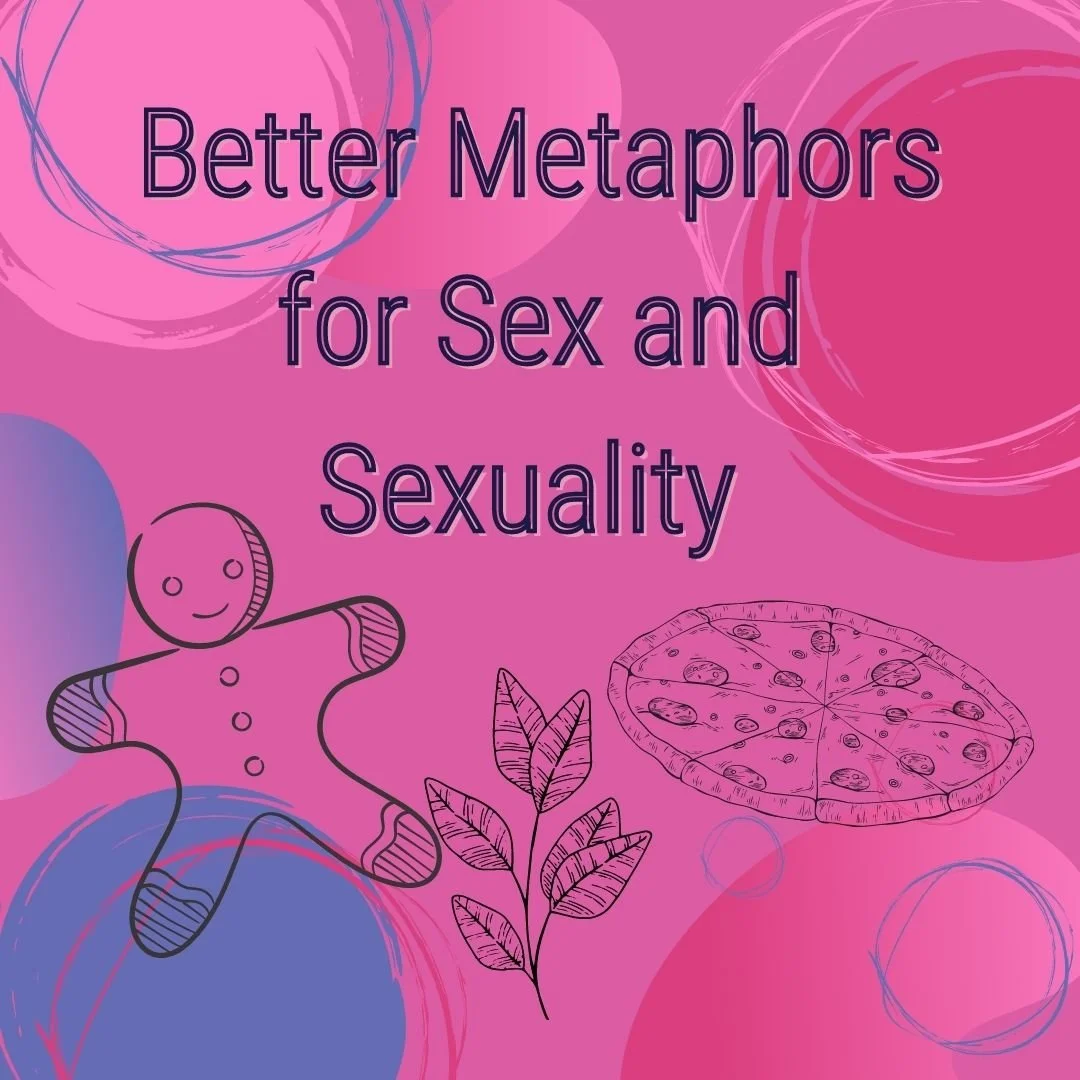
In our society, it is considered inappropriate to talk about sex. Because of this, plenty of analogies are installed to veil the conversation while still having it, but few are accurate or positive. The most common metaphor we use is to describe it like baseball: someone “scores,” there are “bases” to hit, and the ever-present fear of “striking out.” This language is not only competitive and unhealthy, it’s inaccurate to what sex is really about.

SEX ACTS AS A PIZZA

Sex educator Al Vernacchio saw this need for a better way to talk about sex. In his famous Ted Talk, he confronts the issues with the baseball metaphor and presents the solution: Sex as pizza.

During baseball season and (usually) on a pretty tight schedule. When do we have pizza? When we’re hungry We can decide that we’re hungry but recognize that it’s not a good time to eat. Or maybe it’s the best time to eat and you can really indulge. When playing baseball, there is an instant understanding of competition and opposition. When eating pizza, however, there is a sense of community and shared experience. When playing baseball, there is very little communication. Baseball has structured rules and an end goal. Pizza, however, entails communication and even negotiation. Baseball has specific equipment, making it not accessible for everyone. Baseball is less universally understood than pizza is as well. Pizza has millions of flavor and topping combinations, finding a way to meet everyone’s needs. The only goal in baseball is to win. The goal of pizza is satisfaction.

“Clean” and Other Marketing Ploys in the Sexual Wellness World

“Clean” and Other Marketing Ploys in the Sexual Wellness World

For the most part, we understand marketing labels when it comes to food. “Organic,” for example, we know means higher care when into production and therefore it is marked at a higher price. Because food is regulated so heavily, it’s harder for companies to tout something like “organic” or “fair-trade, the same cannot be said for personal care products. Cosmetics, body care, and the like have minimal standards to meet when claiming these terms.

While condoms and personal lubrication are categorized as “medical devices” by the Food and Drug Associate (FDA), there is still much gray area in the personal product industry. Moisturizers, for example, are not regulated and so if lubrication leans more moisturizer, it doesn’t have to meet the same standards as a jug of synthetic, hospital-grade lube. To further contradict, when a moisturizer features certain ingredients that affect the body (like CBD oil), they are now categorized as a “drug,” putting them through entirely different standards.

For this reason, there’s reasonable suspicion when a product features a busy, over-loaded label with every current Sephora buzzword. Here a few you might encounter and could use another look over:

The Difference Between Sex and Gender

The Difference Between Sex and Gender

Sex and gender are two concepts that are commonly confused in our society. This can be frustrating for many of us because confusing sex with gender or vice versa can invalidate someone’s identity. Sex and gender are not the same, and everyone must learn the difference between the two. To put it simply:

“Sex is a label — male or female — that you’re assigned by a doctor at birth based on the genitals you’re born with and the chromosomes you have. It goes on your birth certificate.” (plannedparenthood)

Some individuals prefer to use the phrase “biological sex” when describing their sexual identity. Others use the phrase “ assigned male at birth” or “assigned female at birth.” This assignment of sex takes note of the fact that infants are assigned their sex when they come out of the womb, usually by a doctor. This assignment of sex does not always reflect what’s going on inside someone’s body “... how they feel, or how they identify.” (plannedparenthood) For this reason, it’s essential to be knowledgeable about the process of sex assignment in the first place. Fertilization is a biological process that each and every human undergoes that directly relates to one’s assigned sex at birth:

“Each sperm has either an X or a Y chromosome in it. All eggs have an X chromosome. ● When sperm fertilizes an egg, its X or Y chromosome combines with the X chromosome of the egg. ● A person with XX chromosomes usually has female sex and reproductive organs, and is therefore usually assigned biologically female.

“A person with XY chromosomes usually has male sex and reproductive organs, and is therefore usually assigned biologically male.” (plannedparenthood)

Damaging Misconceptions About Sex Workers

Damaging Misconceptions About Sex Workers

While sex work is finally becoming more normalized in our society, there are still a lot of harmful misconceptions surrounding the job. To destigmatize sex work and validate it as a true profession, it’s essential to explore some of these myths. The Equality Institute provides a great resource on their website called “Unpacking Harmful Myths Around Sex Work,” which is super helpful for this article. It’s noted that:

“Sex work is an industry in which its workers face extreme stigma, violence, and discrimination.” ( equality institute )

In debunking some of these misconceptions, we can hopefully understand how myths come to support this extreme stigma, violence, and discrimination that we see in the industry. Sex work is legitimate work, and sex workers deserve the same respect as individuals in any other profession. Getting educated is the first step in making the sex industry a safer and inclusive space for workers.

Masturbation 101: How often should you do it?

Masturbation 101: How often should you do it?

Masturbation is a wonderful thing. There’s no right or wrong way to masturbate- as long as you’re practicing safe sex with yourself. The act itself has a lot of noted health benefits when it comes to stress relief and the promotion of a healthier sex life. Masturbation “releases dopamine and oxytocin, chemicals that give us a natural high, help us sleep and can even act as a natural painkiller.” (her.ie) When it comes to the frequency of masturbation, though, the answer varies from individual to individual. There isn’t a masturbation formula that will figure out how often you should be masturbating! Instead, it depends on your own individual needs, desires, and sex drive. Sex therapist Tessa Bergin notes the following in an article for her:

“There’s no optimal number of times people need to masturbate, this will vary significantly from person to person...some might feel the desire to masturbate daily, others every now and then.” (her.ie)

Gender Terms “Pocket” Guide

Gender Terms “Pocket” Guide

Language is constantly changing, constantly evolving, and the language for sex and sexuality is no exception. Language, like gender, is fluid and can accommodate everyone who wishes for better identifiers. As this list proves, there are many labels beyond the binary we’re all familiar with. This list focuses specifically on different gender identifiers, sexual orientations, and personal labels instead of an entire dictionary for all things sex-related. So, my advice, bookmark this page, share it with your aunts and grandparents and those new to the vast world of gender terms, and, ultimately, have it handy whenever someone whats to question your language.

These terms and their accompanying definitions came from Chloe O. Davis’ The Queens English: A LGBTQIA+ Dictionary of Lingo and Colloquial Phrases and YouTuber Ashely Mardell’s The ABCs of LBTQ+. As these two sources stress, not all of these terms are used by all LGBTQIA+ people, and, most importantly, some of these terms are not appropriate for people not in the LGBTQIA+ community to use. There are invaluable resources, like The Queens English, that go far more in-depth than I was capable of doing here. Please check them out too.

Evolution of Desire Pt 2: Mate Shopping in 11 Seconds

Evolution of Desire Pt 2: Mate Shopping in 11 Seconds

After covering the basics of the evolution of desire, the cross-research on mate selection, pair-bonding, and particularly the term Mate Shopping, left me asking for more. Surely mate selection has changed greatly, just as desire has, but what does it look like today, in the 21st-century where virtually all “mate shopping” happens online? Are there any similarities still to the dating ways of our ancestors? Searching for a mate is definitely more complicated now, and though some things are still the same, our desire and how we bond is based on the context—the stuff each person brings—instead of just good or bad genes.

Similar to desire, mate selection comes with a preconceived binary. On the one hand, there is the ingrained pop culture narrative of women during their estrus period, are desperate for sex that they’ve turned into a Girl Gone Wild. Her standards are infinitely lower than during the other days of her infradian rhythm and the need for sperm drives her wild—again, the hypersexualized woman. On the other hand, however, is the woman with impossibly high standards—the tease, prude, or bitch. For not wanting a mate enough, she is mocked. Both women are criticized, both are considered broken which is completely false.

Evolution of Desire: Pleasure in Context

Evolution of Desire: Pleasure in Context

Desire is a weighted word. On the one hand, it is worthy to grace many erotica titles, it can be used as a noun to describe the genitals (Think: “His broad hand slid south towards her desire”) and it remains a steadfast description of a character’s current state. Someone is overcome with desire or is pulsating or dripping or brimming with desire. It’s erratic, it’s uncontrollable, it’s animalistic. It can be a fleeting feeling, though, adding pressure to act on the primal pleasure in case the moment never arises again. This leads to the hyper-sexualized woman trope, the one who desperately searches for anyone that can please her ever-growing urges. She’s sex-crazed! She’s in heat!

Yet on the other hand is the other weaponized version of desire: That of low desire. Another term that fills titles and headlines, low desire is often paired with scientific jargon and equated with negativity. The common narrative follows that if and when you have low desire, you are broken. Therefore, products flood the market to boost one’s low desire—pills, supplements, powders—for both men and women, though certainly women are the main target.

But what is desire? Does it only happen when we’re “in heat”? Can humans even be in heat? And when we do feel like our desire is low, is it fixable? To answer these, let’s first examine the hormonal system. Estrus refers to the short window of about five days—the days leading up to and including ovulation—in which there is a chemical change in the female’s brain. In the vast majority of mammalian species, during estrus, the female is more sexually receptive, as in more welcoming of male advances, and sexually proceptive, as in actively seeking sex. It is only at this time do the females require sex to conceive offspring, once this window closes, so does she.

Disney’s Sexual Health Lessons

Disney’s Sexual Health Lessons

As one can imagine when searching “sex and Disney,” there’s much to sift through. The majority focus on the not-so-hidden sex in Disney movies such as the sexual innuendos you have glossed over as a child. For the most part, many of these have been “debunked” by a HuffPost interview with Tim Sito, a former animator for Disney. When the pieces weren’t discussing the different erections in The Little Mermaid, they were harsh (but true) critiques of Disney (and movies in general) for perpetuating rape culture, misogynistic ideals, and, quite frankly, the patriarchy.

Personally, I’m interested in language. Both of those types of articles—the fluff pieces and the call-outs—are valid, but when we fixate on the negative, are we not simply manifesting it more? Perhaps if we shift our perspective, from narrowing in on the bad and incessantly picking it apart, to the good and celebrate it.

Using Dr. Doug Braun-Harvey’s Six Sexual Health Principles—Consent, Non-Exploitative, Honest, Shared Values, Protection, Pleasure—as inspiration, below is a selection of Disney movies that successfully bring an important lesson in sexuality. I recognize that these movies are targeted towards children and families and, for the most part, are not explicitly about sex. But they are about relationships, marriages, self-love—all critical for healthy sexuality.

The Female Hormonal Advantage

The Female Hormonal Advantage

Do you feel your timing is off? That the 24-hour day somehow doesn’t have enough time in it to complete the ever-mounting to-do list? All day, every day, we are to push ourselves to the limit to produce and create, causing us to overstretch, overexert, and overwhelm. For those with vulvas, this might feel especially true. Why? Chances are you’re living on the wrong clock.

Women’s hormone expert, Alisa Vitti, wants you to jump onto the right clock, the “right-timing” as she says. She is speaking about your infradian rhythm, the lengthier sister to the 24-hour day cycle The infradian rhythm, also known as your menstruation cycle, consists of around 28-days and takes place over four phases, each with its own change in brain chemistry and optimization for different things from nutrition and exercise to communicating, rest, and productivity.

In her book In the Flo: Unlock Your Hormonal Advantage and Revolutionize Your Life, Vitti presents her decades of research. Vitti is, understandably so, furious with how the world has failed her and every other vulva-owner by not prioritizing this incredibly important aspect of their bodies and lives.

During one’s menstruation cycle, many changes occur in the body. In a small breakdown of the infradian rhythm, Vitti demonstrates how our metabolism speeds up and slows down predictably across the month and that you need to change what you eat and the intensity of your workouts each week in order to optimize your metabolism. Indeed, your cortisol levels are higher in one part of your infradian rhythm, so pushing yourself through intense workouts (which already creates cortisol) only increases the stress and inflammation in the body, adding to the anxiety and lack of focus.

So how do we jump onto this “right timing”? Start by tracking your cycle and following Vitti’s anagram POWR—Prepare, Open Up, Work, Rest—to know what to do in each cycle.

The Somatic Approach to Sexual Healing

The Somatic Approach to Sexual Healing

Mindfulness and other wellness practices have become pretty mainstream. It seems every day we’re told to slow down, take a breath, savor the moment, and this ideology is ever-present in the world of sexuality. Indeed, emotional sexual healing has many names in our field: Holistic sexuality, sexual embodiment, somatic sexuality, and more, though ultimately all terms point to turning inwards, connecting with the self, and feeling the body for emotional release. As practices such as these spring up, it’s easy to feel suspicious. Can something as benign as feeling your feet on the ground really help release trauma? The answer? A resounding yes.

Marie Thouin-Savard is a leading expert in this holistic sexuality. Her book, Erotic Mindfulness: A Core Educational and Therapeutic Strategy in Somatic Sexology Practices, details:

“The main premise for using somatic modalities in therapeutic settings is that powerful emotions such as shame, guilt, disgust, anger, helplessness, and fear are in some sense stored within the body, particularly in the tissues of pelvic and sexual organs as tension and pain and therefore often remain out of reach for pharmaceutically oriented cures and talk therapy.”

Trauma is stored in the body, particularly the muscles. Our bodies and emotions can handle a limited amount of stress, so when that limit is exceeded, trauma is created. If that trauma is not released, it festers in the body, causing pain and erosion of health. We use our emotions as the vehicle to release trauma--therefore a way to release pain--but this is a skill that requires practice.

What’s important to note is Thouin-Savard’s last bit: That sometimes this pain remains “out of reach” for pharmaceuticals and other forms of therapy. Therefore, this trauma can only be released with the help of one’s state of consciousness which, as shown in Thouin-Savard’s research, is affected by where one’s attention is coming from. Noticing the where is the entire goal of mindfulness, which is why erotic sensations prove a great starting point for somatic exploration.

The Capitalist Myth of Feminine Freshness

The Capitalist Myth of Feminine Freshness

Recently I was back home visiting family when my mother said she had something to give me. She explained, in great detail, that what she was about to hand me was extremely difficult to find. The coveted item, of which she gave me three, was Vagisil’s OMV No-Sweat Wipettes.

The packaging is small and compact, alluding to its level of discreetness, while displaying bright colors and a confetti-designed wrapper as if to say “I don’t care that you look at my wipes, I’m proud of them!” The wipes promise a “gentle cleanse without irritation” and they insist they’re “pH balanced,” though there is no information about what that actually means. Lastly, the wipes are fragrant with a “vanilla clementine” scent. Other products in the OMV line have scents like “light mixed berry” or “juicy watermelon.”

They do say big things come in small packages and nothing is as big as the myth of vulvar/vaginal freshness. Gynecologist and advocate of truth, Dr. Jen Gunter is the first to tell you that no, you’re vulva does not smell, and if it does seem off, to contact your doctor instead of store shelves. Gunter’s blog, The Vajenda, is her home base for revealing facts and standing up for science. In a recent post, “Merchants of Shame,” she denounces the varying companies that peddle:

“An array of washes, wipes, sprays, suppositories, powders, deodorants, vaginal steams, tiny bags of herbs, and douches that claim to do one or more (sometimes all) of the following: prevent or treat odor, balance the vaginal pH, clean, detox, or achieve that elusive goal of feminine freshness.

Breaking the Hymen Myth

Breaking the Hymen Myth

“How am I 30 and I didn’t know this?” My cousin said to me, laughing though I knew she was serious.

“Probably because no one wants you to know,” I responded, laughing as well but just as seriously.

We’re talking about hymens. As both sexually active adults, we haven’t necessarily thought about our hymens in quite some time; they are no longer on our radar as “virginity” is a thing of the past for both of us. I had just told her the astonishing but scientifically accurate information that vulva-owners, regardless of sexual activity, have a hymen. And, as you can see, she was floored.

Yes, if you’re someone waiting to have vaginal intercourse until marriage, you have a hymen. What they don’t tell you is that if you’re someone who’s been with multiple sexual partners and is living a free-flowing lifestyle, you still have your hymen. You didn’t “break” it. But that’s not what you were told.

We are brainwashed to believe that the hymen is more than it really is. So what exactly is the hymen? A quick Google search immediately shows Planned Parenthood’s definition:

“The hymen is a thin, fleshy tissue that's located at the opening of your vagina. ... Just like other parts of our body, hymens are a little different for everyone. Your hymen can be stretched open the first time you have vaginal sex, which might cause some pain or bleeding.”

While Planned Parenthood is an excellent resource, they don’t always get everything right. First of all, they talk about hymens in regards to virginity—and the act of “losing it”—instead of simply talking about hymens as a biological phenomenon.

Women as the Scapegoat: Cassandra Speaks Review

Women as the Scapegoat: Cassandra Speaks Review

How would history be different if the stories were told by the women? Cassandra Speaks: When Women are the Storytellers, the Human Story Changes answers just that. Provocatively looking at the “What If” of history's oldest stories, author Elizabeth Lesser urges us to reconsider the elements of humanity we've long upheld. Lesser is the co-founder of Omega Institute and a New York Times Bestseller. She’s also a member of Oprah Winfrey’s Supersoul 100, a collection of one hundred leaders who are using their voices and talents to elevate humanity. Cassandra Speaks is Lesser’s third book.

In Part One, Lesser explores storytelling as a concept and how stories have infiltrated and shaped history. Indeed, historian Sally Roesch Wagner says “History isn’t what happened. It’s who tells the story.” Lesser speculates that the reason some stories endure, and why stories exist in the first place, is because:

“Life is hard. It’s confusing. We have enough intelligence to ponder existence, but not enough to really understand what’s going on… That’s why we tell stories. To ease the anxiety of being soft-skinned mortals. To give order to what feels out of control. To guide, to blame, to warn, to shame. To make sense out of why people do what they do.”

Stories provide the foundation for the why and the how of existence, or else some of us would feel particularly aimless. But rarely are we given all of the stories on existence. Instead, especially in Western society, we are taught only a small percentage of the full History; one that leaves out critical events and the voices of women and people of color.

The Unethical History of 70’s Porn

The Unethical History of 70’s Porn

If you’ve read our recent articles on pornography, you’re no stranger to the wonderful world of ethical pornography. Ethical porn is that which is made legally, respects the rights of performers, has good working conditions, shows both fantasy and real-world sex, and celebrates sexual diversity.” (abc.net.au) Unfortunately, the history of the porn industry most definitely does not reflect the values that present day ethical porn does. In the ‘70s, the porn industry was not an ethical place and ethical consumption was not promoted. These issues carried over into the industry’s treatment of it’s performers. Today, I want to make space to discuss the history of the porn industry through the eyes of the worlds “first” full length pornographic film stars: Linda Lovelace. With the rise in acceptance of sexual liberation in the ‘70s, pornography production was also on the rise. 1972 saw the release of Deep Throat, the worlds first full length pornographic film. The character of Linda Lovelace (played by Linda Boreman) serves as a symbol for feminine oppression during the ‘70s, consequently emphasizing the patriarchal fight for power in the porn industry. More than this, her role in the history of the industry serves to show the need for ethical standards to be strictly enforced and followed.

OnlyFans: What Is It and How Is It Changing the SW Industry

OnlyFans: What Is It and How Is It Changing the SW Industry

OnlyFans has become one of the most widely known NSFW social media platform in the past few years. While there has also been recent controversy surrounding Bella Thorne’s use of the platform, a lot of people don’t know just exactly what OnlyFans is. The platform has been around for less than a decade but has had quite the influence on the porn industry:

“Founded in 2016 by Tim Stokely—an entrepreneur who first created a bondage and fetish site in 2011 that allowed people to pay porn performers for custom content—OnlyFans allows content creators to post content and receive payments directly from “fans” via monthly subscriptions or one-time tips.” (fightthenewdrug)

Ultimately, OnlyFans is like an extension of Instagram- in which a user can place a paywall between their content and their auidence. Followers pay a fee to creators they subscribe too. The fee can range from $4.99 to $49.99 per month, along with a minimum of $5 tips or paid private messaging. For creators on the app, “OnlyFans takes a 20 percent cut of creator’s earnings and claims to only share users’ personal information to third-party payment processing companies for ‘verification purposes’.” (fightthenewdrug) In this sense, the platform provides opportunity for a lot of creators to earn steady revenue if they produce content. A lot of influencers use OnlyFans to extend their social media accounts, most notably Instagram and Twitter. Twitter is one of the most NSFW friendly social medial platforms in terms of visibility and a lot of OnlyFans creators promote their content on Twitter as a result. OnlyFans has digitized sex work and in turn has laregely imacted the SW industry.

Queer Nature: Love is Love in the Animal Kingdom

Queer Nature: Love is Love in the Animal Kingdom

The use of the animal kingdom as a metaphor for sexual interactions has been the standard for decades. Indeed, how and when to have the feared “birds and the bees talk” perpetually circles parenting groups. Learning about sex through animals is key to simplify complicated topics and keep children (and adults!) engaged. However, given Darwin’s Theory of Evolution, these animal and sex conversations are done in terms of different-sex sexual behavior and the obvious goal of reproduction.

Same-sex sexual behavior in animals is considered to contradict Darwin’s theory—any of these interactions must be a fluke. Yet researchers have discovered over 1000 species that exhibit same-sex sexual behavior, some scientists even say upwards of 1500 species. Many animals use same-sex interactions to bond, for pleasure or safety, and

Since we already rely on animal behavior to do the heavy lifting of our sexual education, it’s imperative we show all sides of nature’s story. Same-sex sexual behavior happens in more than just humans, here are just a few of this endless list.