

What if the way we conceptualize our clients is unintentionally leaving people out?
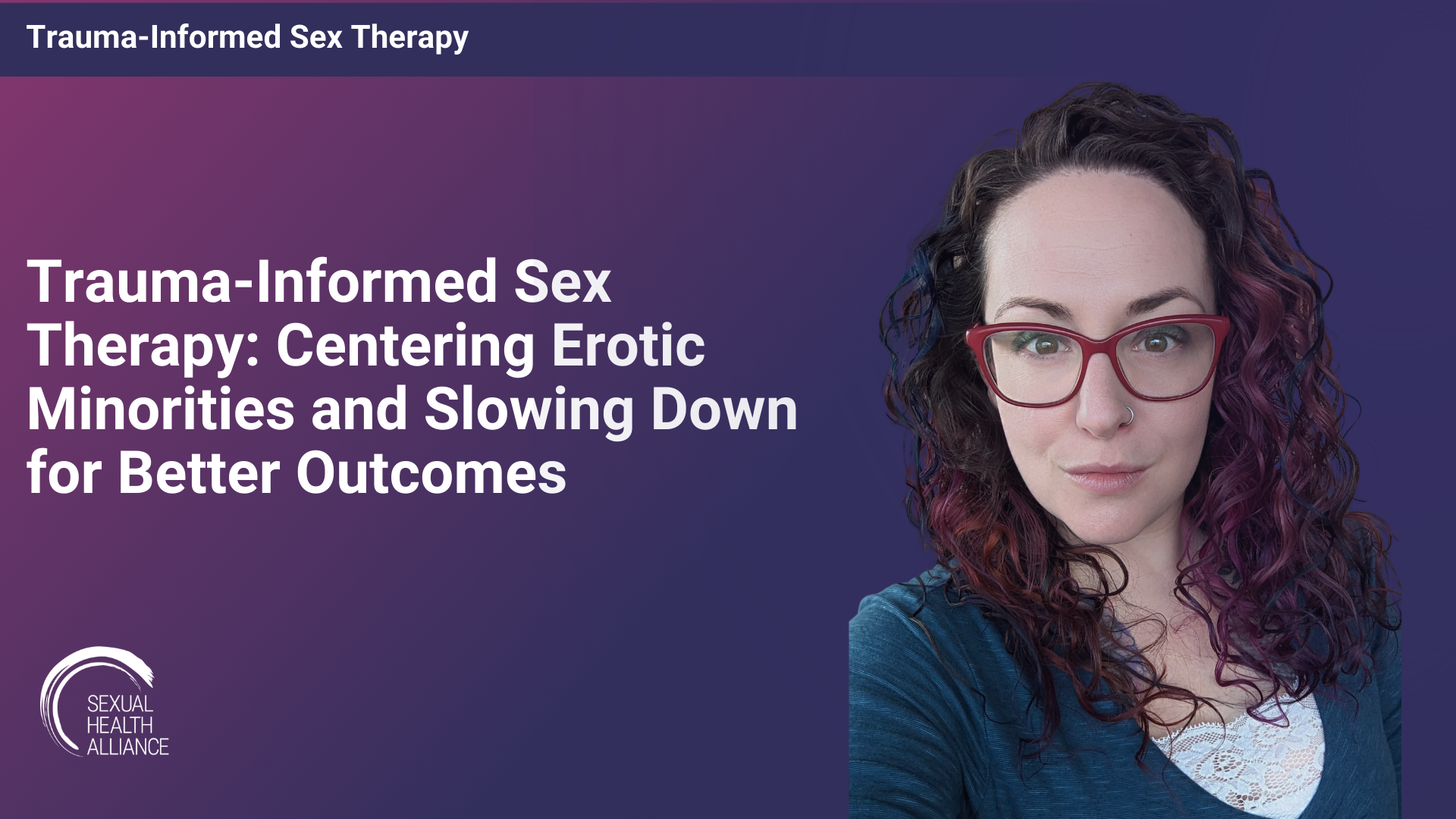
In this powerful interview, Amanda Jepson, LPC, ACS, SHA and AASECT-Certified Sex Therapist, challenges clinicians to rethink how we design and deliver sexual health interventions. As a co-founder of Respark Foundation and a Clinical Therapist at the University of Colorado-Colorado Springs Veterans Health and Trauma Clinic, Amanda specializes in working with active duty and veteran military members, first responders, and survivors of combat trauma, abuse, and sexual assault.
Her message is clear: Trauma-Informed Sex Therapy is not optional—it is essential.
And it begins with who we include in our clinical imagination.
Expanding Our Lens: Who Are We Leaving Out?
Sex Therapist Amanda Jepson introduces a term that deserves more attention in clinical spaces: erotic minorities.
When we talk about erotic minorities, we are referring to individuals who fall outside socially normative sexual identities and experiences. This includes:
Queer and LGBTQ+ individuals
Trans and gender-diverse people
Disabled individuals
People of color
Larger-bodied individuals outside “straight sizing” norms
People practicing consensual nonmonogamy or kink
In other words, erotic minorities are those who are often overlooked when interventions are developed, researched, and normed.
Amanda urges clinicians to pause and ask:
When we choose an intervention, who was it designed for?
Many traditional sex therapy techniques were created and validated within dominant, heteronormative, cisgender populations. When those same interventions are applied universally, outcomes can differ—sometimes dramatically—from what was intended.
Trauma-Informed Sex Therapy requires us to consider not just what works, but for whom it works.
Why Normed Interventions Can Miss the Mark
Clinical interventions do not exist in a vacuum. They are shaped by cultural assumptions about sexuality, bodies, relationships, and identity.
When those assumptions reflect only dominant identities, erotic minorities may experience:
Misalignment with the intervention’s structure
Unintended harm or retraumatization
Increased shame
Reduced therapeutic effectiveness
Amanda challenges therapists to critically evaluate whether the tools they are using were designed with inclusive populations in mind.
This is not about discarding evidence-based practice. It is about recognizing that evidence must be contextualized.
Trauma-Informed Sex Therapy asks clinicians to adapt, modify, and co-create treatment plans with clients rather than rigidly applying standardized models.
The Essential Insight: Blend Trauma-Informed Care Into Everything
When asked what single insight could move the needle in sexual health, Amanda does not hesitate:
Blend trauma-informed care into your work.
In many therapy circles, there is an implicit belief that therapy should move at a certain pace. There is an unspoken expectation about how quickly clients should progress or how interventions should unfold.
Trauma-Informed Sex Therapy disrupts that assumption.
Instead of asking, “How fast can we move forward?” we ask:
What does safety look like for this client?
What pace feels accessible?
What does readiness actually mean here?
Amanda explains that integrating trauma-informed principles:
Slows therapy down
Increases accessibility
Improves outcomes for all clients—not just those with known trauma histories
Even clients without identified trauma benefit from this approach because it respects autonomy, consent, and nervous system regulation.
The myth of one-size-fits-all therapy dissolves under trauma-informed care.
Slowing Down in Practice: Rethinking Sensate Focus
Amanda offers a practical example: sensate focus.
Sensate focus is a multi-layered, staged touch exercise commonly used in sex therapy to reduce anxiety and build intimacy. Traditionally, therapists guide clients through stages in a fairly structured sequence.
But Trauma-Informed Sex Therapy shifts the emphasis from structure to readiness.
Instead of pushing clients through stages at a predetermined pace, Amanda encourages clinicians to:
Introduce “stage zero,” such as setting the environment or keeping clothing on
Allow clients to remain in stage one as long as needed
Avoid rushing progression simply because a model suggests it
The difference may seem subtle. It is not.
When clients control the pace, several things happen:
Autonomy increases
Anxiety decreases
Shame diminishes
Trust strengthens
And trust is the foundation of effective sexual health work.
Trauma-Informed Does Not Mean Trauma-Centered
One of the most important clarifications Amanda makes is that trauma-informed care benefits everyone.
Trauma-Informed Sex Therapy does not assume every client has trauma. Rather, it assumes that:
Safety is foundational
Consent must be ongoing
Nervous systems respond differently under stress
Clients deserve pacing that aligns with their lived experience
This shift alone transforms the therapeutic environment from directive to collaborative.
Instead of therapy happening to the client, it happens with them.
Intersectionality and Sexual Health
Amanda’s clinical work is deeply intersectional. She supports clients navigating:
Combat trauma
Physical and sexual abuse
Sexual assault
Vicarious trauma
Consensual nonmonogamy
Kink
Identity exploration
Trauma-Informed Sex Therapy recognizes that identity factors intersect with trauma in complex ways.
For example:
A queer client may carry both sexual shame and religious trauma.
A disabled client may face medicalized stigma around pleasure.
A larger-bodied client may have internalized body-based rejection that impacts intimacy.
If our interventions assume normative bodies and experiences, we risk reinforcing those wounds.
Intersectionality is not an optional add-on. It is central to ethical sexual health practice.
Clinical Conceptualization: The Quiet Power of Reframing
Amanda emphasizes that conceptualization shapes intervention.
If we conceptualize a client’s avoidance of intimacy as “resistance,” we may respond with pressure.
If we conceptualize that same behavior as a protective strategy rooted in past harm, we respond with compassion.
Trauma-Informed Sex Therapy invites us to ask:
What function is this behavior serving?
What protection is being attempted?
What would safety look like instead of performance?
This reframing reduces pathologizing language and increases client empowerment.
Better Outcomes Through Slower Work
In a culture that prizes speed and efficiency, slowing down can feel counterintuitive.
But Amanda’s clinical experience suggests otherwise.
When therapy is paced collaboratively:
Dropout rates decrease
Emotional regulation improves
Clients report greater satisfaction
Long-term change becomes more sustainable
The slower path often becomes the more effective one.
Trauma-Informed Sex Therapy challenges the assumption that faster equals better.
Sometimes slower equals safer.
And safer equals deeper healing.
What Future Therapists Must Understand
For clinicians entering the field, Amanda offers a clear directive:
Consider who your interventions were built for.
Ask yourself:
Were erotic minorities included in the research?
Does this model assume a specific body type?
Does this framework rely on heteronormative scripts?
Does this pace account for nervous system dysregulation?
Trauma-Informed Sex Therapy is not a niche specialization. It is a standard of care.
Future sex therapists must be prepared to:
Adapt models
Center marginalized identities
Respect pacing
Hold space for complexity
Dispel shame
Because sexual health work does not exist outside of trauma, culture, and power dynamics.
Final Reflection: Moving From Inclusion to Intention
Amanda Jepson’s message is both practical and provocative.
Inclusion is not accidental. It requires intention.
Trauma-Informed Sex Therapy asks us to:
Slow down
Expand our clinical imagination
Question default assumptions
Center those historically excluded
Prioritize safety over speed
When we do, therapy becomes more accessible. More ethical. More effective.
And perhaps most importantly, it becomes more human.
That is how we truly move the needle in sexual health.
Want to become an in-demand sexual health professional? Learn more about becoming certified with SHA!

