

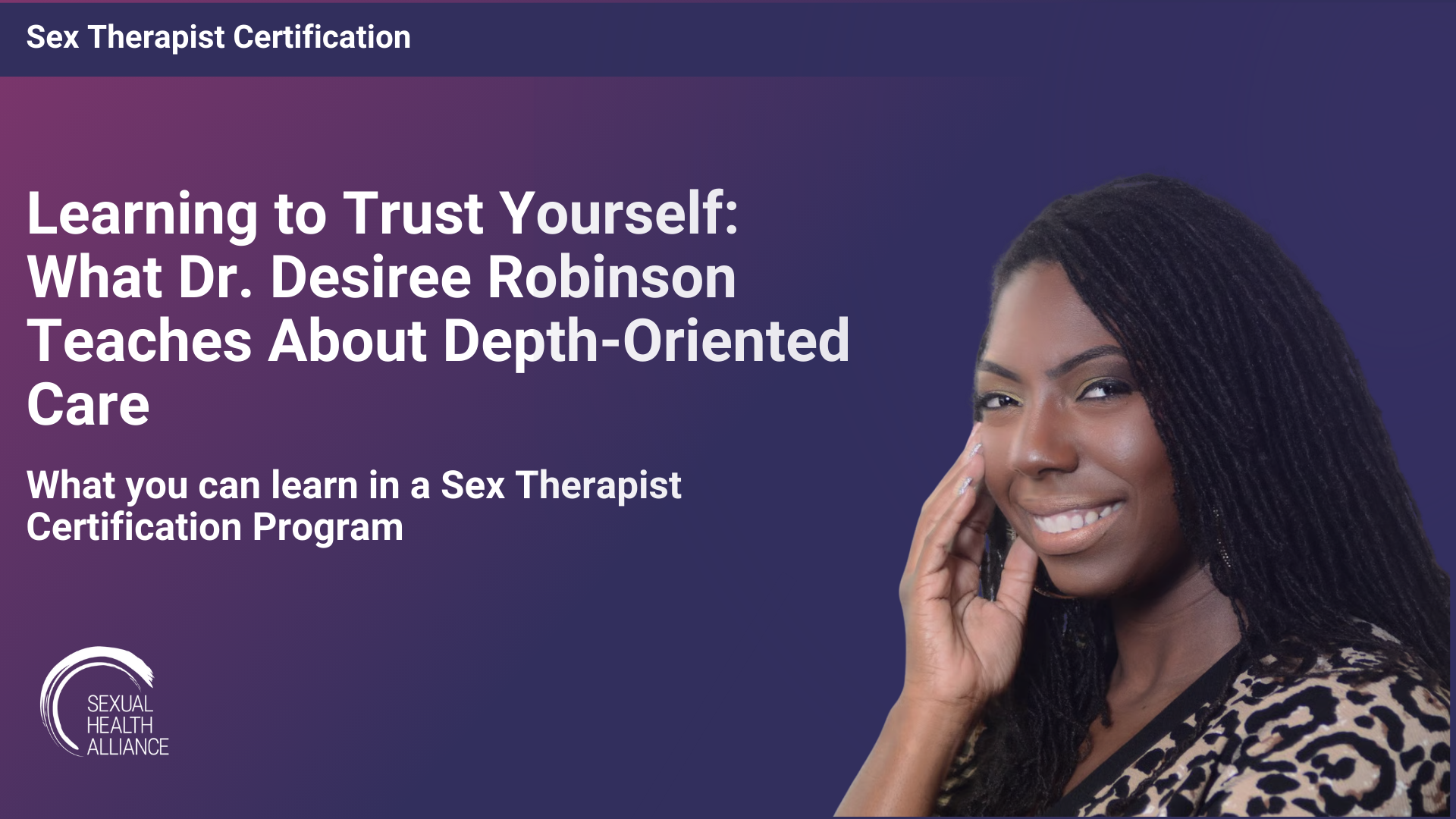
“It’s okay to learn how to trust yourself.”
That simple statement may sound obvious. But as Dr. Desiree Robinson explains in this interview, self-trust is not something we inherit from social media, peers, or even our parents’ generation. It is a skill developed through self-knowledge, lived experience, and trial and error.
For professionals pursuing sex therapist certification, this message is more than personal advice. It is clinical wisdom. The ability to help clients trust themselves begins with cultivating that capacity within ourselves.
In this conversation, Dr. Robinson shares her origin story, the frameworks she uses—including Internal Family Systems (IFS) and Emotionally Focused Therapy (EFT)—and what the next generation needs to understand about boundaries, dignity, and relational health.
From Curiosity to Calling: Choosing Sexual Health as a Specialty
Dr. Robinson’s path into sexual health work began with curiosity.
“This was not something that we talked about,” she explains. In fact, the active avoidance of sexual topics is what drew her in. The silence surrounding sexuality sparked a deeper question: What happens to people when we don’t talk about this?
As soon as she knew she wanted to become a therapist, she knew she wanted to specialize in sexual health.
That instinct is common among professionals who eventually pursue sex therapist certification. The field often calls people who are willing to step toward what others avoid. Sexuality, shame, identity, trauma, desire—these are tender, complex areas. They require clinicians who are both clinically trained and deeply self-aware.
Sex therapy may be sensationalized in media, but Dr. Robinson is clear:
Therapy is beautiful work. It’s depth-oriented work. It supports people in their most shameful, strenuous, or difficult seasons.
This reframing is essential for anyone considering sex therapist certification. The work is not about shock value or sensational topics. It is about dignity, integration, and healing.
Internal Family Systems (IFS): Working With All the Parts
One of the primary frameworks Dr. Robinson uses is Internal Family Systems (IFS).
IFS proposes that we all have “parts”—different internal aspects of ourselves that serve protective or adaptive functions. Anger, avoidance, even self-harm behaviors can represent parts that once developed to protect us.
She uses the analogy of the film Inside Out. In the movie, characters try to eliminate sadness—only to discover that every emotion plays a necessary role. You cannot simply get rid of one part without disrupting the whole system.
In IFS-informed sex therapy, this framework becomes incredibly powerful.
When someone experiences sexual aversion, desire discrepancy, or arousal difficulties, we can ask:
What part of you is trying to protect you?
What is this reaction doing for you?
What would happen if this part didn’t exist?
Instead of pathologizing symptoms, IFS invites curiosity. For clinicians pursuing sex therapist certification, this shift—from fixing to understanding—is foundational.
Sexual symptoms are rarely isolated from the rest of the system. Once medical factors are ruled out, what remains are protective strategies, attachment wounds, internal narratives, and embodied memories.
IFS helps integrate the mind, body, and genital experience instead of separating them.
Mind, Body, Genitalia: Integration in Sex Therapy
Dr. Robinson notes that sexual concerns often involve attempts to separate mind from body—or body from genitalia. But healing requires integration.
When clients present with sexual challenges—especially those with histories of addiction or trauma—the question becomes:
What protective function is this behavior serving?
IFS provides tools to explore that function compassionately. The goal is not to eliminate parts, but to help them relax their roles when they are no longer needed.
For professionals pursuing sex therapist certification, this integrative mindset is crucial. Sexual concerns are rarely “just physical” or “just psychological.” They are systemic.
The work becomes less about performance and more about relationship—to self, to body, to partner.
Emotionally Focused Therapy (EFT): The Attachment Lens
In addition to IFS, Dr. Robinson uses Emotionally Focused Therapy (EFT), which is rooted in attachment theory.
EFT asks: How are emotional bonds forming or rupturing within this relationship?
Sexual challenges often reflect attachment dynamics:
Pursuer–withdrawer patterns
Fear of abandonment
Fear of engulfment
Emotional disconnection
Viewing sexual struggles through an attachment lens reframes them from “what’s wrong with us?” to “what’s happening in our bond?”
For clinicians completing sex therapist certification, EFT provides structure for working with couples in a way that strengthens secure attachment rather than escalating conflict.
IFS helps with internal parts.
EFT helps with relational patterns.
Together, they create a comprehensive approach to sexual and relational health.
Therapy Is Not What Pop Culture Says It Is
Dr. Robinson also addresses an important misconception: therapy is often sensationalized.
In reality, it is slow, layered, depth-oriented work.
Professionals entering the field through sex therapist certification must understand that the work involves sitting with shame, complexity, and vulnerability. It requires patience. It requires clinical excellence. And it requires respect for the human dignity of each client.
The goal is not quick fixes. It is integration and growth.
The Most Important Message for the Next Generation
When asked what message she would give Gen Z and Gen Alpha, Dr. Robinson returns to her central theme:
It’s okay to learn how to trust yourself.
Self-trust is not built through comparison on social media. It is not determined by what friends are doing or what previous generations taught.
It is built through:
Trial and error
Self-knowledge
Reflection
Relational awareness
Common sense grounded in lived experience
She highlights a cultural shift toward individualism: “What I need. What I want. What you must do for me.”
While autonomy matters, she emphasizes responsibility. You are responsible for your own boundaries. You are responsible for your dignity.
That includes practical decisions—like not responding to messages after 9 p.m. if that violates your values.
Boundaries are not declarations. They are behaviors.
If you say you are unavailable after 9 p.m. but continue responding, you undermine your own dignity.
For both clients and clinicians, this is profound guidance.
Boundaries, Dignity, and Self-Respect
Dr. Robinson speaks candidly about the importance of honoring your own limits.
If you do not respect your own needs, you erode your sense of self.
And if your boundaries are not respected? You can leave—with pride and a sense of deserving.
For professionals in sex therapist certification programs, this lesson applies personally and clinically.
You cannot teach dignity if you do not practice it.
You cannot help clients set boundaries if you do not honor your own.
Sexual health work demands strong internal alignment. Without it, burnout is inevitable.
Why Sex Therapist Certification Matters
Sexual health is complex. It intersects with trauma, attachment, identity, addiction, embodiment, culture, and relational dynamics.
Sex therapist certification provides structured education in:
Sexual health assessment
Trauma-informed care
Attachment theory
Evidence-based frameworks like IFS and EFT
Ethical clinical practice
Cultural humility
But perhaps most importantly, it cultivates the clinician’s own self-awareness.
Because at the core of this work is self-trust.
Clients do not need therapists who have all the answers.
They need therapists who can tolerate complexity.
They need therapists who are curious rather than reactive.
They need therapists who embody dignity.
Final Reflection: Trust Yourself, Then Help Others Do the Same
Dr. Robinson’s message is both simple and radical.
Learn to trust yourself.
Develop your own yes and no.
Honor your boundaries.
Understand your parts.
Strengthen your attachments.
From that place, you can help others do the same.
For clinicians considering sex therapist certification, this is the heart of the work. It is not about external validation. It is about integration, dignity, and depth.
And when we model that internally, our clients feel it.
That is how therapy truly moves the needle.
Want to become an in-demand sexual health professional? Learn more about becoming certified with SHA!

