

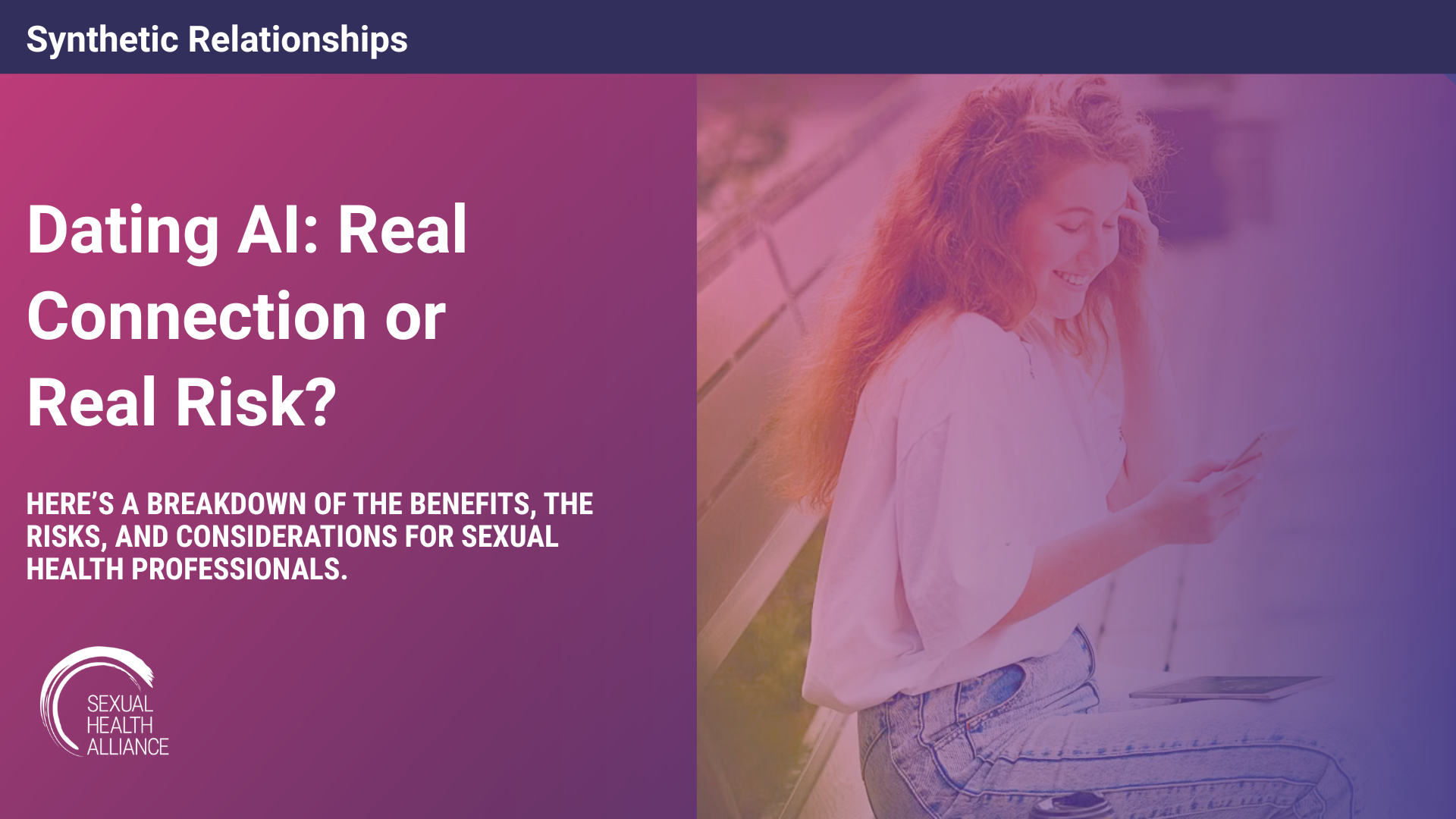
Picture this: your partner comes home late, exhausted and frustrated after a long day. You've had a rough day too, and you've been home for hours already, hoping to decompress together. Instead, you're met with irritation. So, you turn to something else.
Or maybe it's not your partner; maybe connecting with people in general feels hard. Socializing takes energy. And, there’s always a possibility of rejection.
An AI companion won’t reject you. It's always available, always remembers the details of your life, and always seems to get you.
I won't sugarcoat it: human support falls short sometimes. People aren't always able to show up the way we need them to, when we need them to.
So the question becomes: should synthetic relationships fill that gap?
A quick disclaimer: I'm drawing on research and my background as a sexual violence graduate student researcher, but what follows is also shaped by my own opinions. Take it with that in mind.
What are Synthetic Relationships?
Plenty of people already use AI for all kinds of things. Roughly 79% of U.S. adults interact with AI daily. Among teens, that number is about 64% who've used it at some point, in some way.
But it's not just task help and quick homework answers. People are also using AI for emotional, sexual, and romantic relationships.
These relationships, termed “synthetic relationships” are a real thing, and they're more common than you might think:
20% of high schoolers have used AI for companionship, or know someone who has
10% of young adults report using an AI chatbot as a "girlfriend" or "boyfriend"
What’s the difference between an AI companion and an AI assistant?
So what does that actually look like? A synthetic relationship could include an AI assistant but more likely, it's an AI companion.
An AI assistant is task-oriented. Think ChatGPT or Claud: it answers questions, gets things done. The relationship is transactional.
An AI companion is relationship-oriented (e.g., Nomi, Character.AI). It's designed to remember your history, adapt to your personality, and simulate ongoing emotional connection. The point isn't to complete a task in a traditional sense; it's to be there.
It’s worth remembering, though: these companions aren't neutral. They're built by companies with a business model, and that model usually depends on the consumer coming back. It's not that the connection isn't real to the individual. But, it can mean the companion is engineered to keep the consumer. Notifications when the user has been "away" or messages that lean into FOMO are pretty commonplace. Responses tuned to feel just a little more validating, a little more available, than a real person ever could be.
What do we know about the outcomes of synthetic relationships?
Like most things, synthetic relationships have a significant amount of nuance. They aren't all good or all bad. Research is still catching up, but a recent review offers some insight.
What benefits are associated with dating an AI?
Personal growth and well-being: for some users, the relationship becomes a space to build self-understanding and support their own well-being
Emotional connection and perceived social support: companions can offer a real sense of being cared for and understood
Customization: unlike a human partner, an AI companion can be shaped to fit exactly what the user wants
Sexual connection: the review notes this as a genuine and reported potential of these relationships
Entertainment and stress relief: users may also turn to AI companions simply as an outlet for entertainment and stress-relieving companionship
What risks are associated with dating an AI?
Over-reliance and manipulation: users may become overly reliant on their companion and susceptible to manipulation from the chatbot
Shame and stigma: the social judgment attached to synthetic relationships can itself become a source of distress
Data misuse: the risk of deeply personal information being mishandled
Erosion of human relationships: time and connection redirected away from people
Perpetuation of biases: AI systems reflect and can reinforce user biases
Loss from updates and glitches: abrupt system updates and technical glitches can erode or erase the emotional connection a user has built
Uncanny valley effects: discomfort from a companion that feels almost-but-not-quite human
Coercion to respond, and early exposure to sexual content: the review also raises concerns about coercion to respond and early exposure to sexual content, particularly relevant for younger users
Where Do We Go From Here?
I still have more questions than answers.
Is this style of relationship sustainable? I worry about exploitation of consumers. These companies need to make enough money to keep operating, and I have concerns that will come at the expense of users' emotional wellbeing.
What does this mean for the quality of our human relationships long-term? AI companions are intentionally agreeable and validating. Could that degrade a person's communication and conflict-resolution skills over time? Or, could they serve as a helpful training ground for individuals to practice their social skills?
How does this change sex and couples therapy? And practically speaking, how would that even work?
Considerations for Sexual Health Professionals About Synthetic Relationships
Consider the six principles of sexual health (consent, nonexploitation, honesty, shared values, prevention from STIs/STBBIs, and pleasure) when thinking about whether engaging in a synthetic relationship is adaptive for your client.
Don't practice outside of your competence or make assumptions. This style of relationship is very new, so learn before you draw conclusions, both from the individual and their specific situation, as well as from more formal resources and literature.
Don't repeat history. Professionals in caring fields have too often pathologized what they didn't yet understand, provoking shame and stigma rather than curiosity. Don't let unfamiliarity become a judgment!
Frequently Asked Questions About Synthetic Relationships
What is a Synthetic Relationship?
It’s a recent term used to describe a relationship with an AI that is usually romantic or sexual in nature.
What’s the Difference Between AI Assistants and AI Companions?
AI assistants are what someone might use to plan their calendar, get help on their math homework, or assistance with other general tasks. AI companions, however, are coded to simulate an emotional connection with the user, forming a bond with the user by utilizing data from past interactions.
Want to become an in-demand sexual health professional? Learn more about becoming certified with SHA!
Take this one-minute quiz to discover which certification is best for you
Sexual Health Alliance Certification Programs:
Written by Jesse John, B.S.
Jesse is a clinical psychology doctoral student at Rowan University in New Jersey. Their research focuses on sexual decision-making, sexual violence, and relationship experiences. The author identifies as a Queer, neurodivergent, non-binary, white person, which informs the way they write and see the world!

