
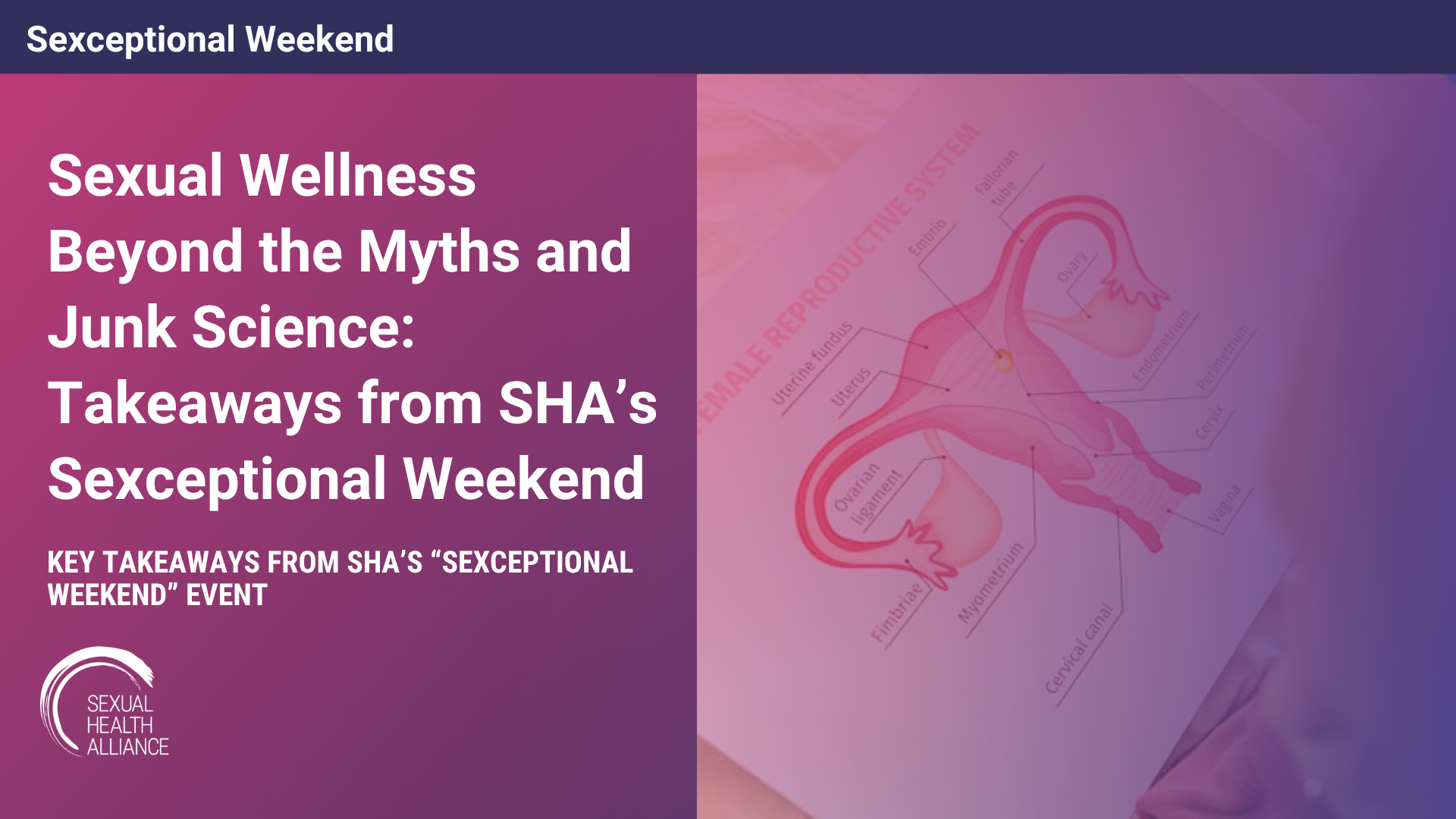
Sexual health education is so vital, especially since it’s often subpar in public schools and even in graduate-level academic settings. To help bridge that gap for both students and professionals, the Sexual Health Alliance hosts monthly "Sexceptional Weekends."
This past weekend’s event was all about clinically grounded sexual wellness. We dove into everything from vulva health myths and HIV/PrEP education to the rise of AI in sex education and how to create engaging content for social media. Honestly, I learned things here that I wouldn't have encountered anywhere else!
For those who couldn’t make it (or just want a refresher!), I have put together the most interesting takeaways. If I tried to cover everything, I'd be writing until the next Sexceptional Weekend in June, or at least until the SAR in May! So here are the key highlights from my first Sexceptional Weekend:
We Need More Education on Vulvas!
As part of the Sexceptional Weekend, I had the opportunity to listen to Dr. Maria Uloko’s talk, and she was an absolute powerhouse. She emphasized that there is zero standardized infrastructure for vulvovaginal health education or diagnostics. Essentially, the medical world is winging it, and patients are paying the price.
Here are some of the heavy-hitting stats she shared:
85 Million: The number of women in the US currently suffering from vulvovaginal conditions.
7 Years: The average wait time just to get a correct diagnosis.
75%: The percentage of doctors who are completely untrained in vulvar anatomy.
Dr. Uloko put it perfectly:
"The vulva is a central organ for identity, pleasure, and function, yet it is shrouded in silence, shame, and a profound lack of scientific and public education."
The "Bladder" Connection
One of the biggest lightbulb moments was the link between vulvar health and bladder health. It turns out that many people who think they are dealing with "recurrent UTIs" might actually have hormonally mediated vestibulodynia. Because of the massive gap in medical training, most doctors won't even think to check for it, leaving patients stuck in a cycle of unnecessary antibiotics.
A Resource to Bookmark
If you’re looking for a place to start taking control of your own health, check out VULVAi. It’s an AI chatbot created by Dr. Uloko and her team to help individuals navigate the complexities of vulvar health.
HIV and its Prevention: Insights from the Experts
HIV and its prevention are often misunderstood, even in 2026. I recently had the privilege to listen to two experts, Stephen Stewart and Dr. Russell Johnson, talk about the current state of HIV, modern prevention methods, and the progress we’ve made.
It was an eye-opening session that reminded me how much of our "common knowledge" is actually outdated. Here are the big takeaways:
What actually is HIV?
HIV is a virus that goes after the body’s "security team"–the CD4 cells (or T cells) that help us fight off infections. Without treatment, the virus reduces the body's ability to defend itself, making people much more vulnerable to illnesses that a healthy immune system could usually handle.
Debunking the Myths
"Is there a cure?" Although seven individuals have been cured through a rare combination of stem cell transplants for cancer and a specific genetic mutation, the best case for most people with HIV is to reduce the amount of HIV in their body.
"Is it a death sentence?" Absolutely not. Thanks to modern medicine (and the Ryan White CARE Act that helps to make that medicine accessible to people in the US), it’s now considered a manageable chronic condition.
"Only gay men get it, right?" Nope. In fact, roughly 60% of people living with HIV globally are cisgender women.
"Can I get it from a hug or a kiss?" Still a hard no. It's spread through condomless sex, sharing needles, perinatal transmission, or blood transfusions. (Note: Over-douching or having an existing STI can actually make you more susceptible by irritating the body's natural barriers.)
"I’d know if I had it." You really might not. 1 in 7 people living with HIV don't know they have it because they haven't been tested.
Treatment & Prevention (The Essentials)
Their presentations offered a plethora of info, and while there are more options than we could fit in one blog post, here are the basics:
Medical Adherence is Key: Taking medication exactly as prescribed is critical; otherwise, the virus can develop drug therapy resistance.
PrEP (Pre-Exposure Prophylaxis): A tool for HIV-negative people who want to stay that way. It’s not just for gay men—it’s important for anyone at higher risk (e.g., if you have a partner whose status you don't know).
PEP (Post-Exposure Prophylaxis): Think of this as the "emergency room" option. It’s a once-a-day pill for people who may have been exposed recently. It’s meant for emergencies, not routine use.
AI as a Source of Sex Education
Dr. Kirsten Greer discussed her recent research and related publications around the benefits and drawbacks of using AI as a modern tool for sexual health information. This part of the talk was particularly fascinating. Since traditional sex ed can be hit-or-miss depending on where you live, many people are turning to chatbots for answers.
The Benefits
For many, an AI feels like a safer, faster teacher than a clunky search engine or an intimidating classroom.
24/7 Access: It’s incredibly convenient. If you have a question at 2 AM, the AI is always "awake" to answer in real time.
Judgment-Free Zone: People may feel more comfortable asking an AI "awkward" questions they might be too embarrassed to ask a doctor or parent.
Surprising Accuracy: Research shows AI currently has a 65–85% accuracy rate for sexual health questions. In many cases, that makes it more reliable than the limited or biased sex ed many people receive in school.
The Drawbacks
As Dr. Greer pointed out, the very things that make AI helpful also come with significant risks.
Age Appropriateness: Because it’s so accessible, AI can be a bit of a gamble. It may provide answers that aren't developmentally appropriate, giving a younger user information that is too graphic or complex.
The "Am I Normal?" Problem: Sexual health is deeply emotional. When someone asks "Am I normal?", an AI provides a data-driven response but may lack the empathy to handle the underlying anxiety or human nuance.
Outdated Info & Misinterpretation: If a user lacks basic sex ed, they might phrase a question in a way the AI misinterprets. Combined with the risk of outdated data, this can lead to a total misunderstanding of the facts.
Safety Concerns: There are genuine concerns about AI filters failing, leading to responses that may become sexually aggressive or inappropriate.
Creating Sexual Health Content Online
Newsflash: People are using TikTok as a search engine these days. (Wild, I know!) Because of that, more sexual health pros are hopping onto short-form video to get the right info out there. Doctors like Dr. Russell Johnson and Dr. Sonya Maya are literally making TikToks when they aren’t working their daily jobs just to combat the tidal wave of misinformation.
Fighting the "Blanket Statement"
Dr. Sonya Maya discussed how prevalent harmful rampant misinformation and out-of-context “blanket statements” are on social media. She highlighted some major myths that need debunking:
Biology Blunders: Myths about "tightness" vs. "looseness" and the oversimplification of things like female ejaculation.
Shame Tactics: Content portraying porn as always evil or masturbation as harmful to your health.
Real-World Impact: She explained how this bad info actually damages people's psychological well-being and their relationships.
How to Actually Reach People
So, how do you,as a sexual health professional, make informative, accurate content without getting scrolled past? Dr. Johnson shared his blueprint for content creating:
The Vibe: Approach sex ed through positivity, humor, and expertise.
Avoid "Dry Journal Clubs": Nobody wants a boring lecture. Keep it short, sweet, and to the point.
The Formula: Use a catchy hook + state your credentials + give 3–5 key points + invite a conversation in the comments.
Overall, he emphasized the importance of staying true to your objectives and staying balanced.
Facts Too Good Not to Share
There was so much covered at the event that didn’t fit into a neat category. I wanted to wrap up with a few interesting facts that were too important to leave out:
Masturbation & the DSM: The first Diagnostic and Statistical Manual of Mental Disorders (DSM), published in 1952 actually listed “excessive” masturbation as a pathological behavior! Thankfully, like homosexuality, it has since been dropped. It’s a wild reminder of how much our medical view of sex is tied to the culture of the time. If you want to learn more, try this article.
The "Doctor" Disclaimer: Just because someone has "Dr." in their bio doesn't mean they're an expert in sexual health. Always check their specific credentials—a PhD in Art History is great, but maybe not the best source for HIV prevention or vulvar health advice.
The CSBD Debate: Compulsive Sexual Behavior Disorder (CSBD) was recently added to the ICD-11, but you can’t actually be diagnosed with it in the US. Why? Because the US hasn't adopted the ICD-11 yet.
The Controversy: It’s a massive "hot button" issue. Is it truly an impulse control disorder? Or is it actually about "moral incongruence" (feeling guilty about sex) and poor emotion regulation? Some experts argue it shouldn’t even be classified as a disorder at all.
Want to become an in-demand sexual health professional? Learn more about becoming certified with SHA!
Written by Jesse John, B.S.
Jesse is a clinical psychology doctoral student at Rowan University in New Jersey. Their research focuses on sexual decision-making, sexual violence, and relationship experiences. The author identifies as a Queer, neurodiverse, white, non-binary person, which informs the way they write and see the world!

