

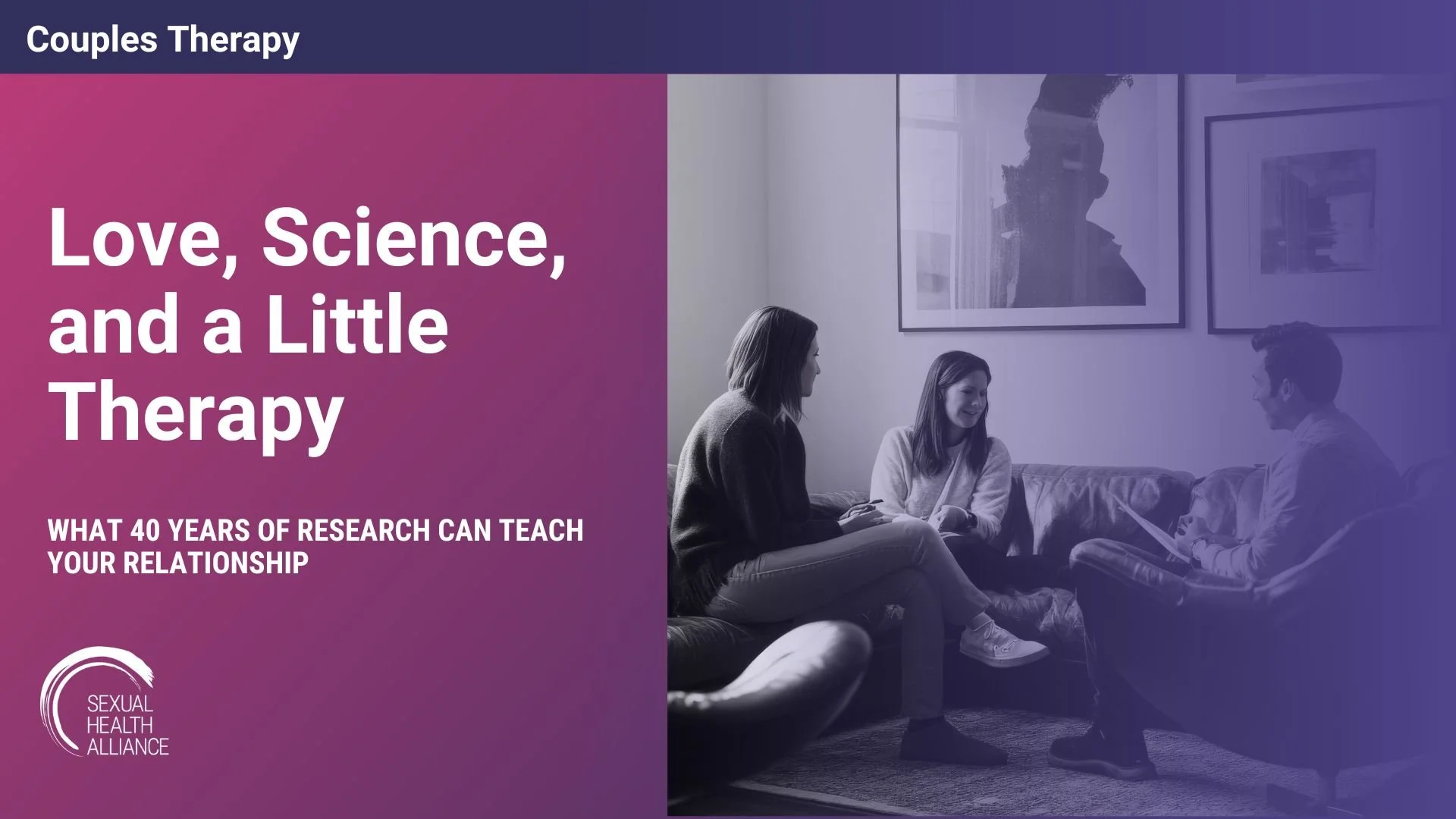
When people hear “couples therapy,” they often imagine crisis mode — slammed doors, late-night arguments, or a relationship on the brink. But the real story is far more hopeful. In fact, research shows that by the end of couples therapy, most people are doing better than 70%–80% of those who don’t get treatment — an improvement as strong as the best therapies for individual mental health.
Four decades of research tell us something clear and inspiring:
It’s becoming more effective.
And it’s evolving to meet the realities of modern relationships.
At SHA, we’re big fans of supporting couples feel closer, communicate better, and bring more joy (and yes, pleasure) into their relationship. Love deserves tools, and therapy gives people the skills, insight, and emotional safety to grow together — not apart.
Today we’re breaking down what decades of science, including several major research reviews, tell us about how couples therapy helps people reconnect, heal, and thrive.
Let’s get into it.
40 Years of Couple Therapy Research: What Have We Learned
A recent major review looked back at decades of studies to understand what really makes couples therapy work. The findings are both comforting and clear: while techniques matter, the heart of healing comes from deep emotional shifts.
Here’s what 40 years of relationship science has uncovered..
1. It’s not just what therapists do — it’s how they do it.
Techniques help, but a therapist’s presence is often what makes change possible. Research shows that emotional attunement, cultural humility, inclusivity, and non-judgment are core ingredients in effective couples therapy.
Some qualities we assume are universally helpful — like warmth — show mixed results. In one study with heterosexual couples, therapist warmth toward husbands increased husbands’ warmth toward their wives, but the effect didn’t go both ways. Warmth may help some, but not in the same way for everyone.
This raises an important question: Does a warm versus more directive approach work differently depending on a client’s attachment style, cultural background, or conflict history?
Couples don’t transform because they learn a new script. They change because they feel safe enough to be real. Building trust and noticing how each partner responds to the therapist’s style is what creates that safety.
2. Emotional moments create the turning points.
Healing happens when couples experience something new emotionally, often for the first time in years. For example:
a partner softening instead of shutting down
receiving comfort instead of criticism
expressing a fear they’ve buried
repairing after conflict
reaching for each other instead of withdrawing
These moments become the building blocks of a new relationship story.
Research shows that emotional responsiveness — not just better communication — is what predicts improvement.
3. Patterns matter more than problems.
Couples rarely get stuck because of a single issue.
They get stuck in cycles:
pursue → withdraw
attack → defend
shut down → escalate
Therapy helps couples see the loop, name it, interrupt it, and eventually replace it. When the pattern changes, the relationship changes–regardless of what the argument was about.
4. Research is more diverse… but still not diverse enough.
The field has made progress in studying representative relationships including:
queer relationships
BIPOC couples
non-monogamous partnerships
couples navigating trauma or systemic stress
But much of the research base still centers:
white
Heterosexual
married
middle-class
U.S.-based participants
With mild-to-moderate relationship distress and limited mental health diversity.
There's movement forward, but plenty left to do.
5. We still don’t fully understand how change unfolds.
While there are many qualitative studies and self-reports, we lack large-scale, quantitative data examining the mechanisms of change — for example:
When during therapy do breakthroughs happen?
Which interventions cause which improvements?
How do shifts in emotional dynamics create long-term change?
The science is growing, but we need more rigorous, real-time measurement.
The Bottom Line, So Far
The research is clear: Couples therapy works because it changes emotional patterns, not because it fixes communication glitches. But there’s still room to deepen our understanding of how, why, and for whom specific interventions work best.
Couples Therapy in the 2020s: A New Era of Connection
Modern relationships look different today — and couples therapy has evolved right alongside them. A second major review highlights some of the most exciting shifts happening right now.
1. Telehealth is not just the future — it’s the present.
Online couples therapy is here to stay. It can help provide more access to:
rural couples
busy professionals
new parents
people seeking culturally safer providers
partners who feel more comfortable in their own home
2. Therapists are finally integrating sex therapy with relationship therapy.
Emotional disconnection affects sexual connection — and vice versa. Modern therapy recognizes that intimacy is not separate from communication; they’re part of the same system.
Couples therapists now help partners explore:
pleasure
desire
erotic safety
sexual communication
authenticity and play
A very SHA-friendly direction, if we say so ourselves.
3. Trauma-informed therapy is now foundational, not optional.
Therapists today are trained to recognize how trauma — personal, relational, and systemic — shapes the way partners connect, protect themselves, and respond to conflict. This includes attachment injuries, past traumas, chronic stress, and identity-based oppression, among other experiences.
Just as important, therapists must reflect on their own assumptions, biases, emotions, and cultural lenses as they work with couples.
Modern couples therapy is more compassionate, nuanced, and context-aware than ever before.
4. Inclusivity is expanding — finally.
Today’s best therapists support a wide range of relationships:
queer couples
asexual partnerships
polyamorous systems
long-distance partners
The field is finally catching up to the real diversity of human relationships.
5. Therapy is moving toward positive sexuality and pleasure frameworks.
Instead of focusing only on “fixing problems,” therapists help couples:
build joy
nurture play
create shared meaning
increase sexual confidence
explore desire without shame
Love isn’t just the absence of conflict. It’s the presence of connection, safety, and pleasure.
So… Why Does Couples Therapy Work?
Across all the research — old and new — the answer is strikingly simple:
Couples therapy is effective in reducing relationship distress. This has been established across various methods including cognitive‐behavioral couple therapy, integrative behavioral couple therapy, and emotionally focused couple therapy. And couples therapy creates a safer, more connected relationship.
Therapy helps couples:
understand each other’s attachment needs
reduce shame and defensiveness
repair emotional injuries
communicate with empathy
integrate sexual and emotional intimacy
build patterns that support closeness instead of conflict
show up with vulnerability, courage, and compassion
It’s not about winning arguments; It’s about reshaping the bond so both people feel safe enough to love fully.
SHA’s Love-Positive Takeaway
Relationships aren’t about perfection; they’re about patterns, vulnerability, and the ability to repair again and again.
Couples therapy helps partners:
feel safer
lower defenses
reconnect emotionally and sexually
rewrite the story of their relationship
And after forty years of research, one message is crystal clear: Couples therapy isn’t a sign of failure — it’s a sign of commitment, growth, and possibility.
It helps people love better, fight gentler, and stay connected. And it’s only getting more effective as the science evolves.
Ready to Take Your Knowledge Even Further?
Couples and sex therapy is more than a career — it’s a calling to help people heal, grow, and thrive.
SHA’s comprehensive training is:
flexible
online
sex-positive
research-aligned
AASECT-informed
community-driven
If you want to make a meaningful impact and earn dual certification, SHA is the best pathway.
Join the nOW in three simple steps:
Fill out an online application HERE.
Complete your online coursework and attend any 3 live weekend conferences that occur once a month.
Become a SHA Certified Sex Therapist (CST) and automatically receive a completed AASECT Application Packet, if desired.
Written by Emma Sell-Goodhand, MPH
Emma is a doctoral student and Global One Health Fellow at North Carolina State University studying adolescent sexual health. She brings prior experience as a Technical Advisor at the World Health Organization.
Want to become an in-demand sexual health professional? Learn more about becoming certified with SHA!

