

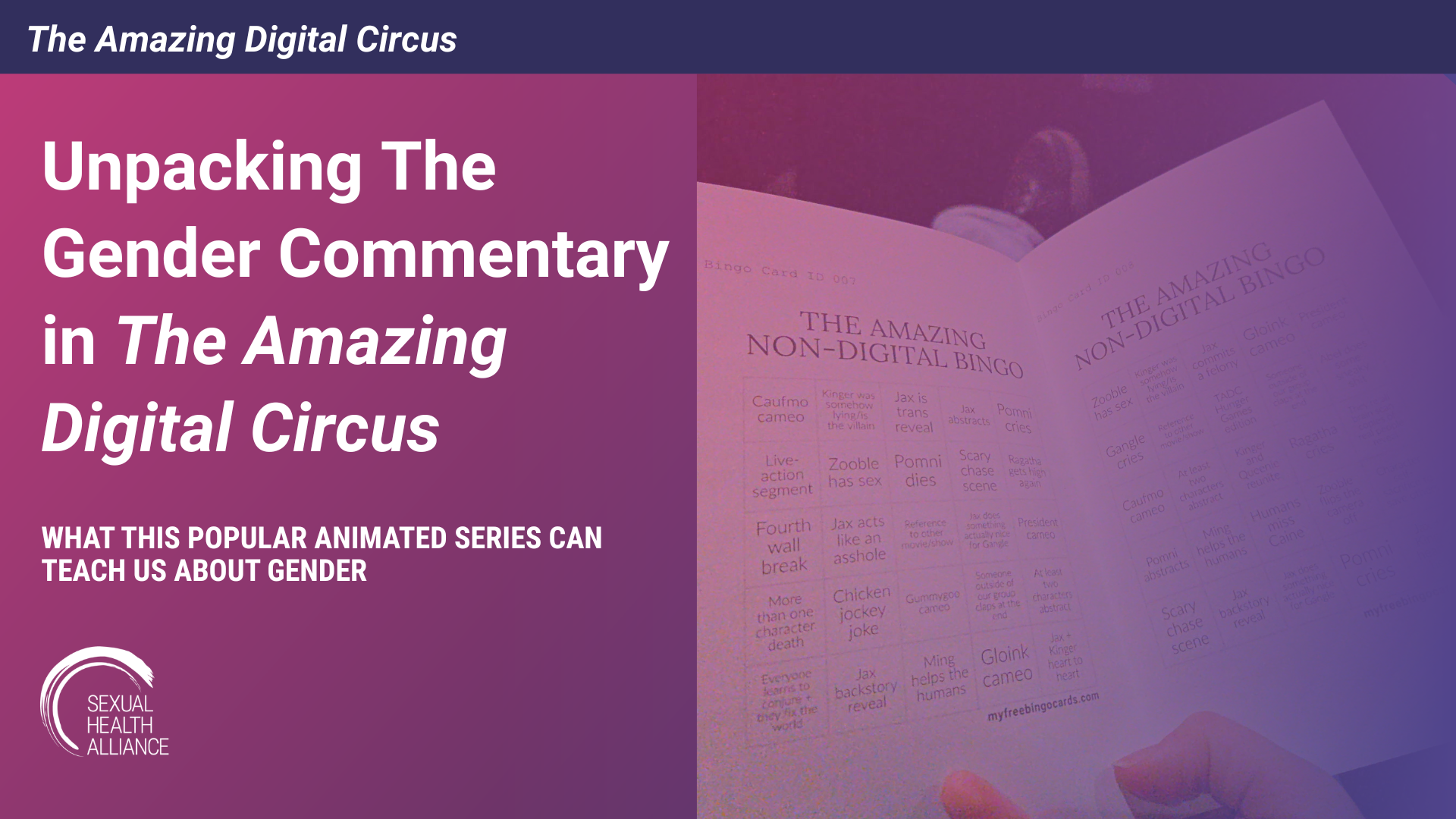
Based on Harlan Ellison’s 1960s sci-fi horror short story “I Have No Mouth But I Must Scream,” The Amazing Digital Circus is coming to an end with its last episode, titled “The Last Act” currently in theaters and out for public viewing. I had the opportunity to see it opening night in theater, and even made a bingo for the event! But, in keeping with the creator’s wishes, this will be published after the finale is made public. So, spoilers ahead. You’ve been warned!
At first glance, the series looks like well-animated brain rot. I actually dismissed it early on as something I wouldn’t enjoy, but kept going because it was apparent my friends saw something in it that I didn’t. My tune has since changed – Gooseworx won me over.
The show is a powerful commentary on a few topics, including the ethics and implications of artificial intelligence (AI) and uploaded intelligence (UI) and a compelling exploration of gender identity through multiple characters. Although these overarching themes are incredibly nuanced and interesting, I am an aspiring sexual health professional, not a computer scientist. So, I’ll mostly be focusing on how gender identity is explored in the show and how I interpreted it.
Overview of The Amazing Digital Circus
The show predominantly features six human characters that are trapped in a digital circus controlled by an AI called Caine. Caine largely misunderstands why the characters are unhappy in the circus and finds it deeply upsetting that they do not enjoy the adventures he puts them through. In each episode the characters learn more about themselves and each other as they suffer through the adventure and try to escape while avoiding “abstracting” which is essentially equivalent to losing their minds and their sense of self.
The finale episode reveals that the human characters are uploaded brain scans of real people that have continued on with their lives. There’s a moment where one of the UI characters, Pomni, recognizes that although she was generated from the brain of a woman named Abigail, Pomni isn’t Abigail. This is the ending I wanted, personally, because it really makes you think about how different circumstances create different people and encourages radical acceptance of someone being a culmination of their experiences.
Jax’s Journey
There is a clear connection between the creator Gooseworx and her character Jax. Discussed at length on her Tumblr account, Jax is semi-autobiographical in that he encapsulates Gooseworx’ own journey as a transwoman. Note that I use “he” to describe Jax because that is the pronoun used throughout the finale episode, indicating where Jax is in his transition.
In the last episode, the audience witnesses an intimate conversation between Jax and his friend Ribbit, in which Jax comes out. What resonated with me is the fallout that follows this conversation. Jax distances himself from Ribbit, leading to her abstraction. Often in the media we see a character so terrified to come out, but once it happens the perfect happy ending ensues. That’s fine, but it lacks the realistic and internalized process that Jax displays. His reaction reminds the audience that facing the people you come out to afterwards can be incredibly difficult, even if they’re affirming.
Zooble’s More Than a Sum of Their Parts
Designed in a “Memphis Group” style, Zooble is modular with parts that can be attached and detached. They are able to control parts of themself outside of their body and their spare parts come from an infinite “Zooble box” in their room. Their construction varies considerably from each episode to the next.
Keeping all of that in mind, Zooble seems to have a clear disconnection from their body because of all these replaceable parts. From that, I think it’s reasonable to gather that Zooble’s experience is literally and symbolically representative of gender dysphoria. It seems that no matter how many times they change their parts, they can't find anything that feels right. I would imagine that many of the fans related to this experience when thinking about their own gender identities and expressions.
The Amazing Digital Circus Fanbase
Artistic expression like The Amazing Digital Circus has a real impact in touching the hearts and lives of Queer people, especially young Queer people. It is a powerful reminder to come as you are and to proudly be yourself. There is something truly special about media made by LGBTQIA+ people for the people in that community. The representation we see in The Amazing Digital Circus coming from Gooseworx – an out and proud transwoman – has the possibility to connect with so many Queer people lacking acceptance from others and from themselves.
That encouragement to live authentically may seem redundant and irrelevant to some, but I vehemently disagree. In tandem with this show, we’ve seen the Chiles v. Salazar U.S. supreme court ruling that banning conversion therapy in Colorado violates free speech, setting a dangerous precedent as well as other legislation that harms LGBTQIA+ people in the U.S.. With that in mind, it is clear that we need Queer joy and Queer love to be front and center.
Frequently Asked Questions about The Amazing Digital Circus
Is Jax really confirmed trans in The Amazing Digital Circus?
In the finale episode, a flashback reveals Jax and Ribbit having an intimate conversation. Ribbit then puts her bow on Jax and he blushes, confirming many fans’ suspicions that Jax is trans.
Does Zoobie get to have sex?
It’s implied, but I would say so based on the hearts around their door during one of the finale episode’s last scenes. It’s up to interpretation though!
Want to become an in-demand sexual health professional? Learn more about becoming certified with SHA!
Take this one-minute quiz to discover which certification is best for you
Sexual Health Alliance Certification Programs:
Written by Jesse John, B.S.
Jesse is a clinical psychology doctoral student at Rowan University in New Jersey. Their research focuses on sexual decision-making, sexual violence, and relationship experiences. The author identifies as a Queer, neurodivergent, non-binary, white person, which informs the way they write and see the world!

