
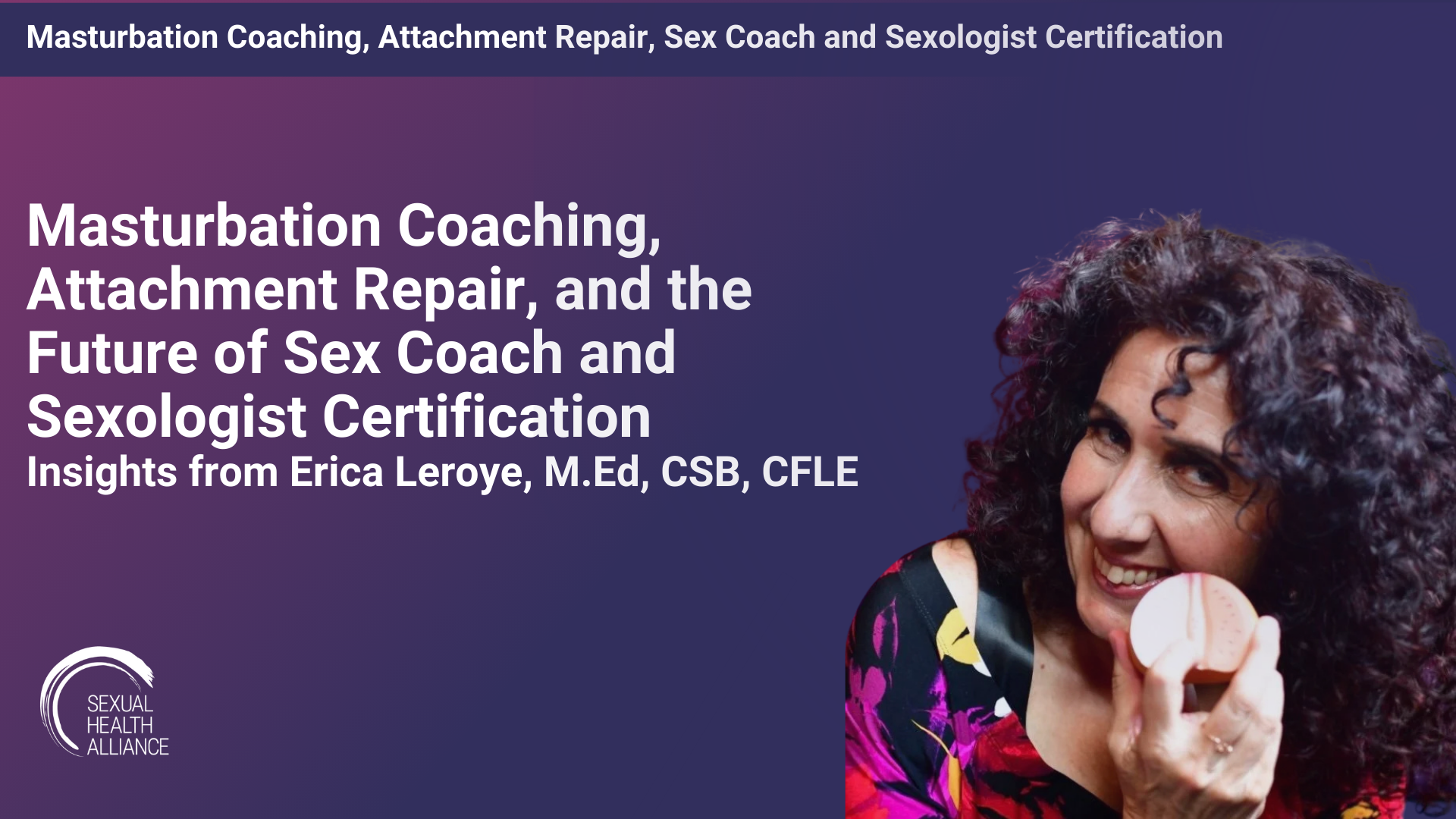
As more professionals pursue a Sex Coach and Sexologist Certification, the conversation around pleasure, embodiment, and trauma-informed care is evolving rapidly. In her interview with the Sexual Health Alliance, Erica Leroye offers a powerful reframe: masturbation is not simply a sexual act — it is nervous system training, attachment repair, and embodied self-regulation.
Erica Leroye, M.Ed, CSB, CFLE, is the founder of Creative Body Release and a Certified Sexological Bodyworker, Human Development Specialist, Healing Arts professional, and Erotic Artist/Educator. With more than 30 years at the intersection of sex education, movement coaching, and caregiver-child attachment work, she brings a somatic, trauma-informed lens to masturbation coaching that is reshaping how professionals think about solo sexual practice.
Her core message? Pleasure can become “secure base” training.
Masturbation as Movement Training — Not Just a Habit
One of Erica’s most compelling insights comes from sports psychology:
“We have to train for what we want to be good at.”
Masturbation, she explains, is a movement activity — just like running or dancing. Yet most people discovered it when they were young and never updated their practice. As adults, they expect partnered sex to feel natural and fulfilling, while maintaining a completely different solo pattern.
This creates what she calls a mind-body split:
What am I doing alone?
What am I doing with others?
What is my mindset about each?
In the context of Sex Coach and Sexologist Certification training, this reframing is critical. Professionals must understand that solo sexual practice is not separate from relational sexuality — it directly informs it.
If someone trains all week swimming and then expects to perform well at basketball on Saturday, frustration is inevitable. The same applies to sexual performance and connection.
Psychological Bodywork: Allowing Pleasure in the Room
Erica’s work draws from Sexological Bodywork, a modality founded by Joseph Kramer. It is unique because it explicitly allows the pleasure-based arousal system — not just fight, flight, freeze, or fawn — to be present in session.
Rather than talking about sexuality abstractly, the body becomes part of the process.
Erica describes it this way:
Medical model: “Tell me how you run.”
Observational model: “Let’s watch you on the treadmill.”
Psychological bodywork: “Let’s go for a run together and observe what’s happening in real time.”
This approach allows practitioners to discern:
Is this difficulty physical?
Hormonal?
Trauma-based?
Nervous system-related?
Attachment-related?
For those pursuing Sex Coach and Sexologist Certification, this somatic literacy is essential. Sexual health is not purely cognitive — it is embodied.
Cortisol, Oxytocin, and the Nervous System Reset
Stress plays a major role in sexual difficulties. High cortisol levels suppress libido and arousal. The mind often interprets stress as:
“I’m too tired.”
“I’m not in the mood.”
“Something is wrong with me.”
Erica emphasizes the importance of executive function stepping in and reframing that narrative.
Pleasure — especially mindful solo touch — increases oxytocin, the hormone associated with bonding, trust, and safety. Oxytocin lowers cortisol. When practiced consciously, masturbation can become:
Immune support
Stress regulation
Nervous system recalibration
Emotional replenishment
This shifts performance from pressure to flow state — where the mind is present but not interfering.
In advanced Sex Coach and Sexologist Certification training, understanding neurobiology is no longer optional. Pleasure is medicine. It is regulatory.
Attachment Repatterning Through Solo Practice
Perhaps Erica’s most groundbreaking insight connects masturbation coaching to attachment theory.
Her early career in Waldorf education and parent-child programs allowed her to observe attachment dynamics firsthand — modeled after Mary Ainsworth’s foundational research.
Attachment patterns (secure, anxious, avoidant, disorganized) are formed early in life. But intellectual awareness of attachment style is not enough to create change.
The question becomes:
How do we create shift?
Erica’s answer: through embodied repatterning.
As adults, many people carry:
Shame about their genitals
Negative self-talk
Disorganized pleasure responses
Anxiety or avoidance around intimacy
Masturbation coaching, when done consciously, becomes a form of self-reparenting.
Instead of:
“What’s wrong with you?”
“You should be different.”
The inner dialogue shifts to:
“You’re okay.”
“I’ve got you.”
“We can explore safely.”
This creates what John Bowlby called a secure base — an internal place of safety from which exploration becomes possible.
For professionals in Sex Coach and Sexologist Certification pathways, this is transformative: masturbation is not merely skill development. It is attachment repair.
Destigmatizing Masturbation in Couples
Erica also addresses a common relational myth:
“If you masturbate, you must not love me.”
Part of professional training in sexual wellness involves reframing masturbation as:
Replenishment
Recreation
Discovery
Self-regulation
Proactive care
The more comfortable practitioners become with masturbation as a healthy physical activity, the more they can dismantle shame for clients.
Changing the narrative changes the outcome.
What This Means for Sex Coaches and Sexologists
As the field grows and more practitioners pursue Sex Coach and Sexologist Certification, Erica’s work highlights several core competencies:
Nervous system literacy
Somatic awareness
Attachment-informed frameworks
Trauma sensitivity
Pleasure-positive education
Reframing performance as flow
Expanding masturbation beyond orgasm
Masturbation coaching is not about “teaching technique.”
It is about restoring the relationship — between mind and body.
Final Takeaway
Erica Leroye’s work challenges us to rethink pleasure entirely.
Masturbation is:
Not a moral issue
Not a selfish act
Not a sign of relational failure
It is a movement practice.
A neurochemical regulator.
An attachment repair tool.
A secure base builder.
And for professionals pursuing Sex Coach and Sexologist Certification, it represents the future of embodied, trauma-informed sexual health work.
Pleasure is not separate from healing.
Pleasure is the pathway.
Want to become an in-demand sexual health professional? Learn more about becoming certified with SHA!

