

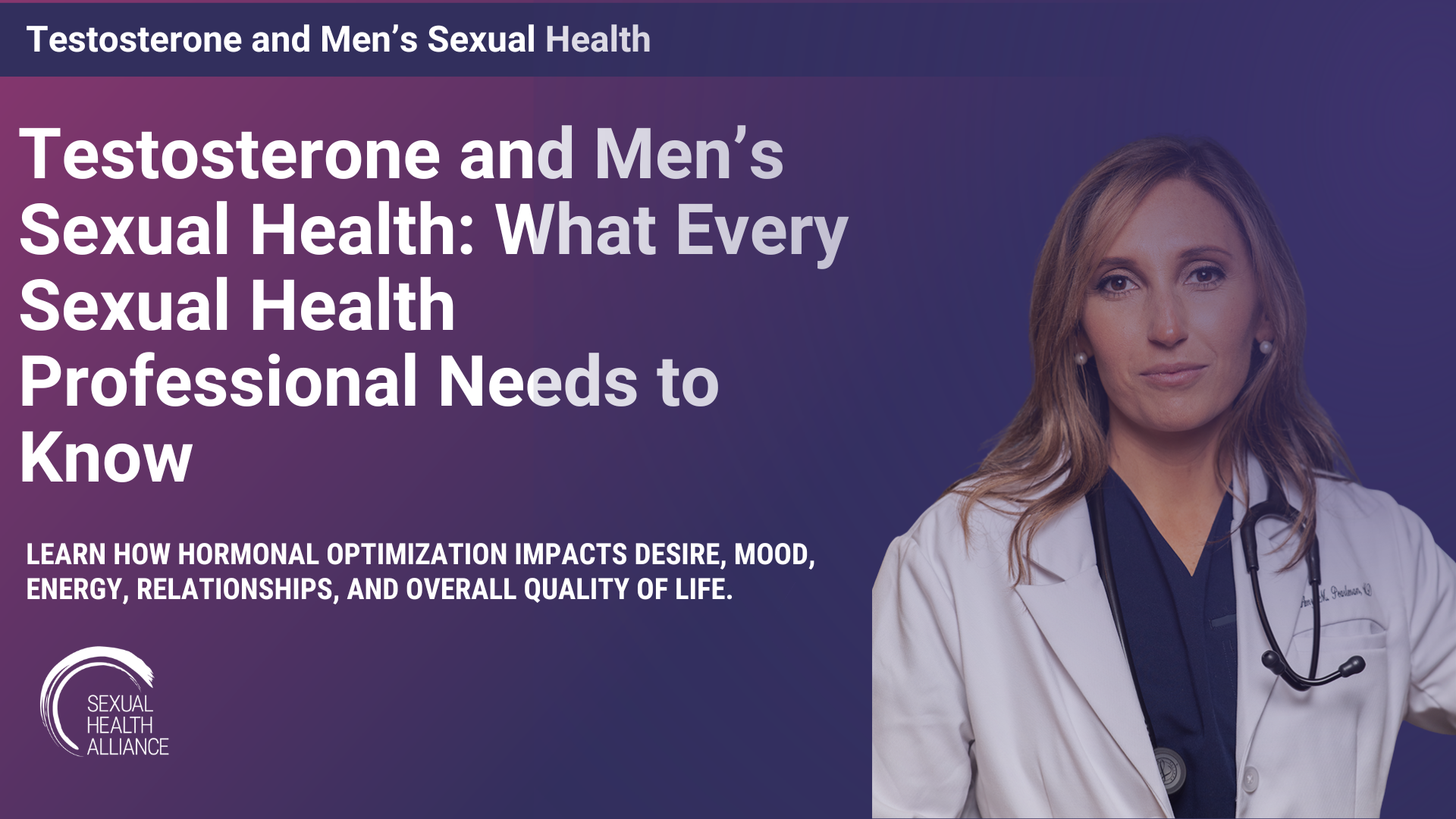
An educational overview of hormonal health, quality-of-life concerns, and why this topic is essential for the next generation of sexual health providers.
Testosterone plays a critical role in men’s emotional, physical, and sexual wellbeing—yet Testosterone and Men’s Sexual Health remains one of the least understood areas of intimate healthcare. Misconceptions are widespread, many clinicians receive minimal training in male hormonal health, and patients often struggle to find evidence-based information.
In a recent SHA interview with Dr. Amy Pearlman, a urologist specializing in men’s health and hormonal optimization, we explored why this topic deserves far more attention from sexual health professionals. Her insights offer essential guidance for clinicians, educators, and anyone who works with male clients or couples navigating sexual concerns.
How Dr. Amy Pearlman Found Her Way Into Men’s Hormonal Health
Dr. Amy Pearlman’s path into men’s health reflects a pattern many providers recognize: medical training often focuses heavily on disease and surgery, while overlooking the everyday intimate health concerns most patients actually bring into the clinic.
Originally drawn to pediatrics and emergency medicine, she ultimately chose urology after encouragement from a mentor—highlighting the profound impact mentorship has on shaping who enters intimate healthcare.
During urology residency, she spent far more time learning about cancer care than about issues like erectile function, urinary symptoms, penile pain, low libido, or hormonal changes. It wasn’t until fellowship that she began focusing on the types of conversations men truly want and need—conversations about Testosterone and Men’s Sexual Health, self-confidence, sexual functioning, and overall quality of life.
For those training the next generation of sexual health providers, her journey offers a clear message: We need more intentional education about men’s intimate health, because most trainees aren’t getting it anywhere else.
Why Talking Openly About Men’s Sexual Health Matters
Many men are eager to talk about sexual worries, hormonal shifts, performance concerns, and changes in desire—but they often don’t know how to start these conversations. Dr. Pearlman describes these discussions as some of the most rewarding in her practice because they give patients their first opportunity to address topics they’ve felt shame or confusion around for years.
Sexual health professionals are uniquely positioned to:
Normalize discussions about sexual functioning
Help men understand their bodies
Identify when symptoms may relate to hormonal changes
Provide supportive education grounded in evidence
Reduce stigma around testosterone testing and treatment
When professionals embrace these conversations, patients often experience not only improvements in sexual functioning but also greater confidence and relational satisfaction.
This is why Testosterone and Men’s Sexual Health is not a niche topic—it is foundational to men’s wellbeing across the lifespan.
The Growing Field of Men’s Aesthetic Sexual Medicine
In her Miami practice, Dr. Pearlman also works extensively in cosmetic sexual medicine, including penile girth enhancement. While this area may seem peripheral to hormonal health at first glance, it is deeply connected to men’s self-esteem, perceived sexual adequacy, and sexual quality of life.
Understanding this trend helps sexual health professionals:
Address questions clients bring about penis size and body image
Reduce shame by offering factual, nonjudgmental guidance
Help men explore the emotional roots of their concerns
Avoid feeding into misinformation commonly found online
Her approach emphasizes scientific clarity rather than promises of dramatic transformation. This balanced perspective is valuable for sexual health educators who encounter clients struggling with anxiety around sexual appearance or performance.
Why Testosterone Matters: A Core Component of Men’s Sexual Health
One of the most impactful themes in Dr. Pearlman’s interview is the value of optimizing hormonal health. She references experts who describe low testosterone as a “reduced state of the human being”—not because every symptom stems from hormones, but because Testosterone and Men’s Sexual Health directly influence how men feel, function, and show up in their lives.
Testosterone affects:
Sexual desire
Energy levels
Mood and emotional wellbeing
Motivation
Muscle development
Ability to lose or maintain weight
Cognitive performance
Relationship engagement
Morning arousal and erectile function
When testosterone decreases, men may experience subtle or dramatic changes. Yet many assume these symptoms are simply “part of getting older.” Sexual health professionals can play a key role by encouraging evaluation rather than resignation.
When Should Men Check Their Testosterone Levels?
Dr. Pearlman is clear: it is never too early to test testosterone.
Young men in their 20s and 30s benefit from having a baseline, and older men benefit from tracking changes over time.
This relates to an important concept in Testosterone and Men’s Sexual Health:
The “delta” matters more than a single number.
Example:
At age 40, a patient’s testosterone is 700 (and they feel great).
At age 60, it drops to 350.
Although 350 is technically “normal,” the decrease of 350 points may cause significant symptoms.
Without baseline data, providers lose crucial insight into these changes.
Encouraging baseline testing helps patients:
Understand their hormonal trajectory
Advocate for themselves in medical settings
Detect changes earlier
Make informed decisions about treatment options
For professionals, this reinforces the importance of integrating hormonal discussion into sexual health evaluations.
Symptoms of Low Testosterone: What Professionals Should Recognize
Symptoms of low testosterone are often vague and overlapping with other conditions. Common signs include:
Fatigue and low energy
Brain fog or forgetfulness
Mood swings, irritability, or low motivation
Reduced libido
Difficulty building muscle
Weight fluctuations
Sleep disturbances
Decreased work performance
Reduced morning erections
Because these symptoms mimic depression, stress, thyroid disorders, or lifestyle burnout, understanding Testosterone and Men’s Sexual Health helps professionals guide clients toward proper medical evaluation rather than assumptions.
The Problem with Over-the-Counter “Testosterone Boosters”
Dr. Pearlman strongly cautions against supplements marketed as testosterone boosters. They are poorly regulated, often misrepresented, and sometimes contaminated with unlisted ingredients.
Instead, she recommends focusing on the fundamentals of hormonal health:
Sleep
Nutrition
Physical activity
Stress reduction
These lifestyle changes form the foundation of effective hormonal support.
Professionals who work with clients on sexual functioning, desire, or mood can reinforce these evidence-based strategies as part of a holistic approach to Testosterone and Men’s Sexual Health.
Safety First: The Most Important Question in Hormone Therapy
Before starting testosterone therapy, Dr. Pearlman encourages asking one core question:
“How could this therapy harm the patient?”
Potential risks include:
Reduced fertility
Worsening untreated sleep apnea
Thickened blood (polycythemia)
Masking unrelated medical conditions
Sexual health providers who understand these risks can educate patients, refer appropriately, and support informed decision-making.
Who Should Evaluate Testosterone?
There is no single right specialty. What matters most is:
Will the provider test testosterone?
Do they know how to interpret the results?
Can they treat the issue—or refer to someone who can?
This flexible, patient-centered approach helps ensure clients receive holistic care for both testosterone and sexual health concerns.
Why Testosterone Education Must Be Central to Sexual Health Training
As Dr. Pearlman points out, most medical and allied health professionals receive no required training on male reproductive or sexual health. This gap leaves many men underserved and misunderstood.
For sexual health professionals, learning about Testosterone and Men’s Sexual Health is essential because:
Hormones influence sexual desire, arousal, mood, and relational engagement
Many men seek therapy first—not a doctor—when they sense something is “off”
Hormonal changes can mimic psychological or relational issues
Knowledge empowers professionals to recognize when medical referrals are needed
Clients feel more validated and understood when providers talk comfortably about hormonal factors
Our field must commit to providing accurate, inclusive education about all aspects of sexual health—including male hormonal wellbeing.
Understanding Testosterone and Men’s Sexual Health is not just beneficial for clinical accuracy; it is foundational to supporting men’s overall wellbeing, relational satisfaction, and sexual confidence. At the Sexual Health Alliance, we remain committed to advancing education in this essential area of sexual health so that professionals feel equipped, confident, and informed when addressing the needs of their male clients.
If you would like additional training or advanced coursework on men’s sexual health, hormonal optimization, or urological concerns, SHA offers comprehensive certification programs to expand your expertise and support best practices in this evolving field.
Want to become an in-demand sexual health professional? Learn more about becoming certified with SHA!

