

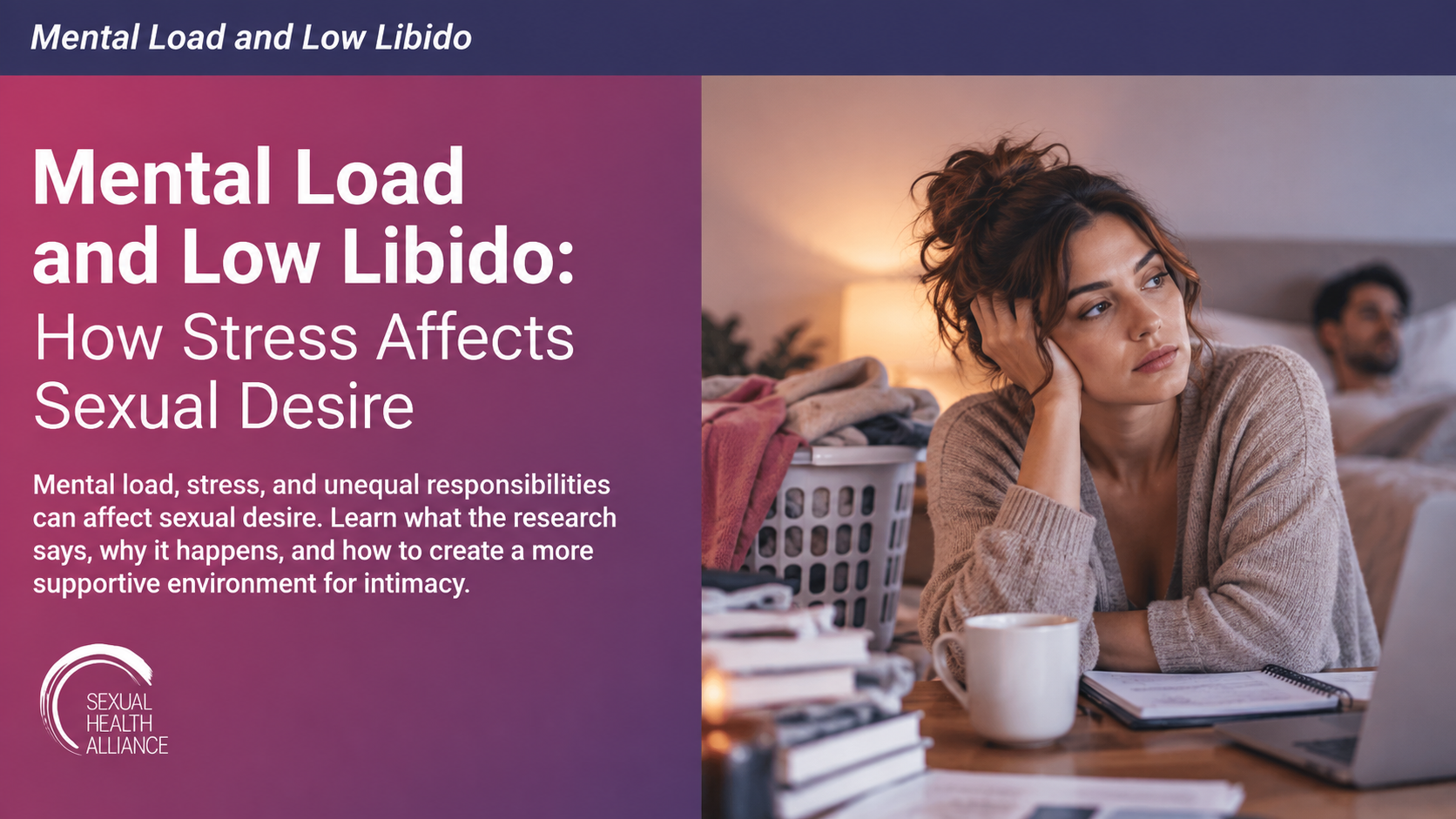
You finally have a moment alone.
The workday is over. The kids are settled. The dishes are done—or at least mostly done. Your partner reaches for you.
And you feel…nothing.
For many people, this immediately raises uncomfortable questions.
Why am I never in the mood anymore?
Is something wrong with my libido?
Am I still attracted to my partner?
Is our relationship in trouble?
Sometimes low sexual desire does deserve medical or psychological evaluation. But desire does not exist separately from the rest of life.
Stress, exhaustion, relationship dynamics, emotional safety, medications, hormones, body image, caregiving, and the invisible work of keeping a household functioning can all influence how available someone feels for sexual connection.
One increasingly important piece of that conversation is mental load.
Quick Answer: Can Mental Load Cause Low Libido?
Mental load can contribute to lower sexual desire, particularly when one partner carries a disproportionate share of planning, remembering, anticipating, organizing, and managing household or family responsibilities.
Research has found associations between unequal household labor and lower partner-specific sexual desire among women partnered with men. More recent 2026 research has also found that how mental load is divided within heterosexual relationships is associated with women's sexual and relationship satisfaction.
That does not mean every experience of low desire is caused by chores or stress.
It does mean sexual desire needs to be understood in context.
What Is the Mental Load?
Mental load is more than completing household tasks.
It is the cognitive and emotional work required to make sure those tasks happen in the first place.
It can include:
Remembering appointments
Planning meals
Keeping track of groceries and household supplies
Scheduling children's activities
Remembering birthdays and family obligations
Anticipating what needs to happen next
Coordinating childcare
Managing school forms and schedules
Noticing when something needs to be cleaned, replaced, purchased, or organized
Keeping track of everyone else's needs without being asked
Two partners may technically divide physical chores while one person remains responsible for remembering, assigning, checking, and anticipating most of them.
That invisible responsibility can be exhausting.
In a conversation on The Sexology Lab, psychologist and certified sex therapist Dr. Nazanin Moali describes how this type of ongoing cognitive labor can become intertwined with sexual desire.
What Does the Research Say About Household Labor and Sexual Desire?
Research increasingly suggests that the division of labor outside the bedroom can matter inside it.
A 2022 study examined women who were partnered with men and had children. Across two studies involving more than 1,000 women, researchers found that doing a larger proportion of household labor was associated with lower sexual desire for a partner. Two factors helped explain that relationship: perceiving the partner as dependent and perceiving the division of labor as unfair.
Read the household labor and sexual desire study on PubMed
A newer 2026 study looked specifically at mental load rather than physical housework alone. Across two studies of heterosexual relationships, researchers found that women's relationship and sexual satisfaction were higher when male partners contributed more to the mental load. In that research, mental load was a stronger predictor of women's satisfaction than physical housework alone.
Read the 2026 mental load study on PubMed
These studies examined specific populations and should not be treated as evidence that the same pattern applies identically to every gender, sexual orientation, family structure, or relationship.
But they reinforce an important principle:
Sexual desire is relational and contextual—not simply an internal biological drive.
Why Can Mental Load Affect Sexual Desire?
Imagine being responsible for managing dozens of unfinished tasks at once.
Even when you are not actively performing them, part of your attention remains occupied by what still needs to happen.
Did someone sign the school form?
Are there groceries for tomorrow?
Who is taking the dog to the vet?
When is that bill due?
What are we doing this weekend?
Did anyone make the appointment?
Then sexual intimacy appears on the schedule.
For some people, shifting immediately from manager mode into curiosity, pleasure, embodiment, and erotic connection is difficult.
This does not necessarily mean attraction is gone.
It may mean there is very little psychological space left for desire to emerge.
SHA has previously explored this broader relationship between stress and sexuality in How Does Stress Affect Sexual Health?
You Don't Always Have to Be "In the Mood" First
One of the biggest misconceptions about sexual desire is that healthy desire should simply appear.
You look at your partner.
You suddenly want sex.
You initiate.
Arousal follows.
That pattern does happen. It is often described as spontaneous desire.
But it is not the only way sexual desire works.
Some people experience responsive desire, meaning sexual interest develops in response to a pleasurable or erotic context rather than appearing beforehand.
Research has long recognized responsive components of sexual desire, particularly when examining sexual response in long-term relationships.
Dr. Moali summarizes the idea this way:
“For most people, desire follows arousal—not the other way around.”
That doesn't mean someone should participate in sexual activity they do not want.
It means feeling neutral before sexual connection is different from actively not wanting that connection.
Someone may begin an intimate experience without strong spontaneous desire and discover that affection, kissing, conversation, touch, playfulness, or other pleasurable experiences allow desire to develop.
Understanding that distinction can remove enormous pressure from people who believe they should automatically feel sexually motivated before anything begins.
SHA explores this concept further in Evolution of Desire: Pleasure in Context
Low Desire Isn't Always a Libido Problem
The word libido can make sexual desire sound like a fixed quantity someone possesses.
High libido.
Low libido.
No libido.
But sexual desire changes throughout life and even from day to day.
A systematic review of sexual desire in long-term relationships found that desire is influenced by a wide range of individual and interpersonal factors rather than behaving like a fixed trait.
Someone might have very little desire while answering emails at 10 p.m. and much more desire while relaxed on vacation.
They might experience desire easily when they feel emotionally connected but struggle when resentment is high.
They may want partnered sex in one season of life and feel little interest during another.
This is why asking “Why is my libido low?” may sometimes be less useful than asking:
“What is happening in the context where I am trying to experience desire?”
When Your Partner Starts Feeling Like Another Responsibility
There is another reason unequal mental load can matter erotically.
When one partner repeatedly has to remind, organize, delegate, anticipate, or manage the other partner's responsibilities, the relationship can gradually begin to feel less like a partnership.
The dynamic may start resembling a manager and employee—or even a caregiver and dependent.
The 2022 household-labor research is particularly interesting here because perceiving one's partner as dependent helped explain the association between household labor inequity and lower desire among the women studied.
Erotic connection and caregiving can certainly coexist.
But feeling chronically responsible for another capable adult can change how someone experiences that relationship.
This is why simply telling someone with low desire to “make more time for sex” may miss the issue entirely.
The problem may not be finding another hour.
The problem may be everything filling that person's mind during that hour.
Emotional Connection Matters, Too
Household labor is only one piece of the picture.
How partners respond to one another emotionally also appears to matter for desire.
Research has found that perceived partner responsiveness—feeling understood, cared for, and valued by a partner—is associated with sexual desire, intimacy, and relationship wellbeing.
That can show up in seemingly ordinary interactions.
Does your partner listen when you are overwhelmed?
Do they notice what needs to be done without waiting for instructions?
Can you express frustration without being dismissed?
Do you feel appreciated?
Can you talk about sexuality without immediately creating pressure for sex?
Sexual connection rarely exists independently from these everyday experiences.
As Dr. Moali puts it:
“Great sex often starts long before anyone takes their clothes off.”
Sharing the Mental Load Isn't Foreplay—and Sex Isn't a Reward
There is an important distinction here.
The takeaway from mental-load research should not become:
If I do more chores, my partner should want sex.
Household responsibilities are not sexual currency.
Sex is not payment for doing dishes, handling bedtime, scheduling appointments, or being an engaged partner.
Sharing responsibility matters because equitable partnerships can change the overall relationship environment.
The goal is not to complete enough chores to earn intimacy.
It is to build a relationship where neither person feels chronically overburdened, managed, ignored, or pressured.
Sexual connection may benefit from that environment—but it is not owed because of it.
How Can Couples Reduce Mental Load?
Start by making the invisible visible.
Instead of talking only about individual chores, talk about who carries responsibility for the entire process surrounding those chores.
For example, doing the grocery shopping is one task.
Knowing what food is running out, planning meals, checking everyone's schedules, writing the list, remembering dietary needs, noticing household supplies, going to the store, putting everything away, and planning what is needed next week is the larger mental load.
Couples can ask:
Who notices what needs to happen?
Who remembers it?
Who plans it?
Who follows up when it doesn't happen?
Who is ultimately responsible if everyone forgets?
Redistributing mental load means sharing ownership, not simply waiting for one partner to delegate more effectively.
Stop Making Every Conversation About Desire Happen in Bed
When sexual communication only happens after someone initiates and someone else declines, the conversation begins under pressure.
One person may feel rejected.
The other may feel guilty or defensive.
Neither is necessarily in a good position to talk openly.
Instead, make conversations about intimacy part of the relationship before something feels wrong.
Talk about:
What has been feeling good lately
What makes connection easier
What has been draining energy
Whether either person feels pressured
How affection is experienced
What kind of touch feels connecting
What each person misses
What has changed
What each partner might want more—or less—of
Communication itself doesn't manufacture desire.
But it can create a better environment for understanding what is supporting or inhibiting it.
What If One Partner Has More Desire Than the Other?
Differences in sexual desire are common in long-term relationships.
Research has examined desire discrepancy as a recurring relationship experience rather than something with a single universal solution.
The goal does not need to be forcing both partners to achieve exactly the same level of desire.
More useful questions include:
What does intimacy mean to each person?
Does the lower-desire partner feel pressured?
Does the higher-desire partner feel chronically rejected?
Are there forms of intimacy both partners enjoy?
Does sex feel pleasurable once it begins?
Is there resentment elsewhere in the relationship?
Are there medical, hormonal, psychological, medication-related, relational, or pain-related factors affecting desire?
A trained sex therapist may help couples explore these questions without treating either partner as the problem.
Professionals interested in developing deeper clinical competency around desire, sexual functioning, intimacy, and relationship concerns can explore SHA's Sex Therapy Certification and Couples & Sex Therapy Certification programs. SHA's Sex Therapy Certification is designed for mental health professionals and graduate students seeking specialized education in sexuality and sexual health treatment.
When Should Low Sexual Desire Be Evaluated?
Mental load is one possible contributor to low desire—not an explanation for every experience.
Sexual desire can also be affected by:
Depression and anxiety
Chronic stress and burnout
Medication side effects
Hormonal changes
Perimenopause and menopause
Pregnancy and postpartum changes
Pain during sexual activity
Sleep deprivation
Chronic illness
Trauma
Body-image concerns
Relationship conflict
Sexual dissatisfaction
Changes in attraction
Other physical or psychological health conditions
If a change in sexual desire is new, persistent, distressing, painful, or accompanied by other physical or emotional symptoms, speaking with an appropriate healthcare or mental health professional can help identify contributing factors.
Low desire should not automatically be blamed on the relationship, hormones, stress, or mental load without considering the broader picture.
Frequently Asked Questions About Mental Load and Sexual Desire
Can stress cause low libido?
Yes. Stress can influence sexual interest, arousal, attention, emotional connection, sleep, energy, and the ability to be present during sexual experiences. However, people respond to stress differently, and some people experience no decrease—or even an increase—in sexual interest during stressful periods.
What is responsive desire?
Responsive desire refers to sexual interest that develops after someone begins experiencing an enjoyable or erotic context rather than before it. Research supports responsive patterns of desire, although sexual response varies widely among individuals and situations.
Does not being spontaneously in the mood mean I have low libido?
Not necessarily. Some people rarely experience spontaneous desire but can experience strong desire after intimacy or arousal begins. What matters is the individual's experience, whether the pattern has changed, and whether it causes distress.
Can unequal household labor affect sexual desire?
Research involving women partnered with men has found an association between doing a disproportionate share of household labor and lower desire for a partner. Researchers have also found associations between shared mental load and women's sexual satisfaction in heterosexual relationships. These findings should be understood within the specific populations studied rather than generalized to every relationship.
Does doing more chores improve your partner's libido?
Not automatically. Sharing household and emotional responsibilities can contribute to a more equitable and supportive relationship, but sex should never be treated as a reward for completing chores.
Why do I want to want sex but still don't feel desire?
This experience can have many possible explanations. Stress, exhaustion, responsive desire, medications, hormones, pain, relationship dynamics, body image, emotional wellbeing, and other factors can all influence sexual interest. A sexual health professional can help explore what may be contributing when the experience is persistent or distressing.
Sexual Desire Needs Context
Sexual desire is often treated as something we either have or do not have.
But desire is more dynamic than that.
It responds to bodies.
Relationships.
Stress.
Pleasure.
Health.
Responsibility.
Safety.
Novelty.
Fatigue.
And the circumstances in which intimacy is being asked to happen.
When someone's desire changes, the most useful response may not be asking how to make them want sex more.
It may be asking:
What is making desire difficult to access right now?
That question creates far more room for curiosity—and far less room for blame.
Hear the Full Conversation
This article was inspired by The Sexology Lab's conversation with psychologist and certified sex therapist Dr. Nazanin Moali about responsive desire, stress, emotional safety, mental load, relationship dynamics, and why good sex rarely happens as effortlessly as popular culture suggests.
Then invite readers to explore the complete episode:
Why You're Not in the Mood (And There's Nothing Wrong With You) | Dr. Nazanin Moali | Episode 26
This article is for educational purposes and is not intended to diagnose or treat sexual, relational, physical, or mental health concerns.

