Careers in Sexual Health: Career Paths, Training & Certifications
Sexual health is a multidisciplinary field with career opportunities across mental health, healthcare, education, coaching, research, media, and sexual wellness.
Some professionals become sex therapists or sexuality counselors. Others build careers as sexologists, sex coaches, sexuality educators, researchers, healthcare professionals, relationship coaches, or sexual wellness experts. The education and credentials you need depend on the work you want to do.
Sexual Health Alliance (SHA) provides professional education and certification for people building careers in sexual health, including training in sex therapy, sexology, sexuality counseling, sex coaching, and sexuality education.
What Careers Are Available in Sexual Health?
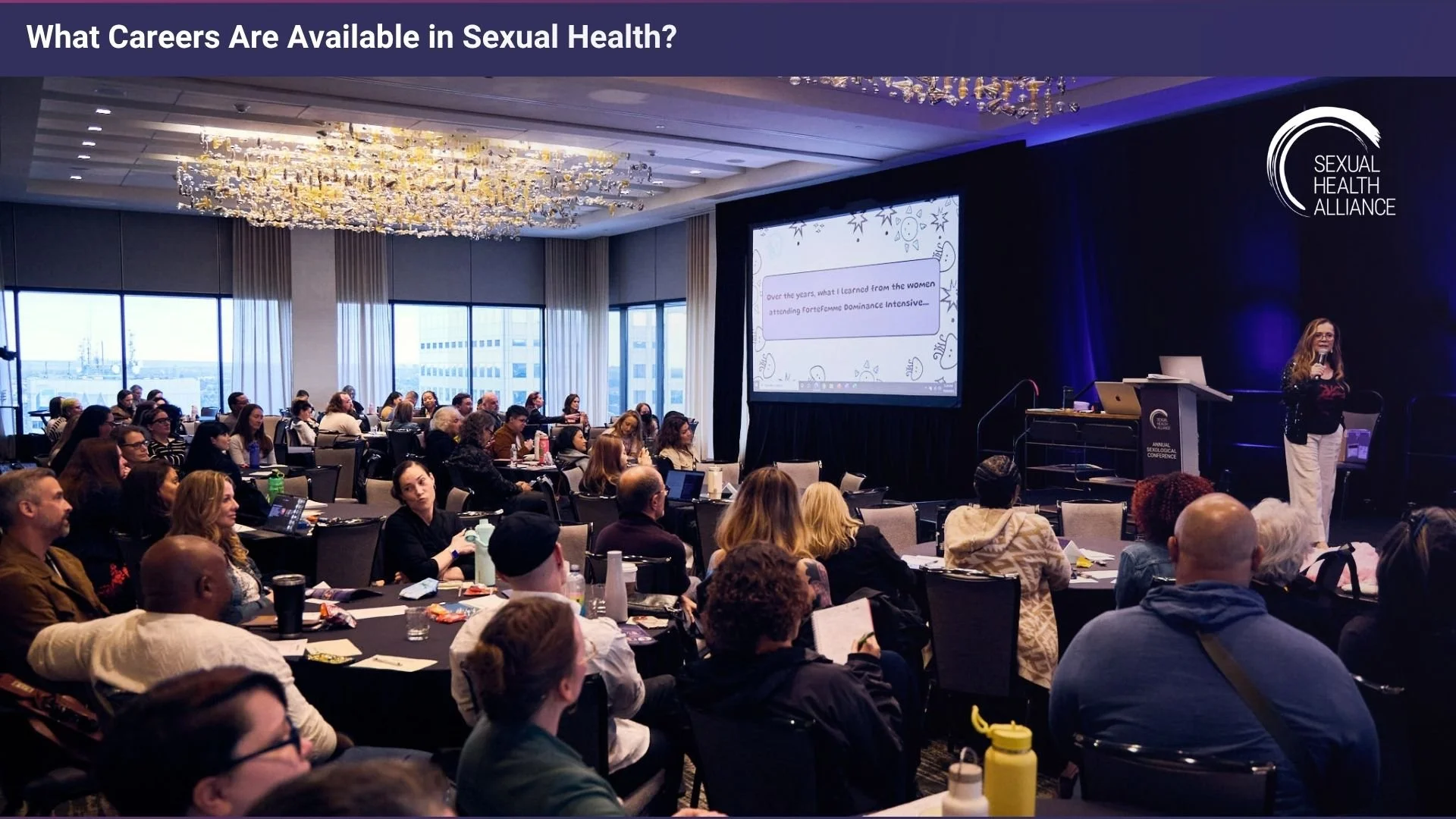
Careers in sexual health include sex therapist, sexologist, sex coach, sexuality counselor, sexuality educator, relationship coach, researcher, academic, healthcare professional, intimacy professional, and sexual wellness consultant.
Clinical careers such as sex therapy require appropriate graduate education and professional licensure, while education, coaching, sexology, and other career paths have different training and credential requirements.
The right career path depends on whether you want to provide therapy, counsel, coach, educate, conduct research, provide healthcare, or work more broadly in sexual wellness.
What Is a Career in Sexual Health?
Sexual health is much broader than treating sexual dysfunction.
The World Health Organization describes sexual health as encompassing physical, emotional, mental, and social well-being in relation to sexuality. Sexual health also involves respectful relationships, access to accurate information, safety, and freedom from coercion and discrimination.
That breadth is reflected in the careers available within the field.
Sexual health professionals may work with topics including:
Relationships and intimacy
Sexual function and pleasure
Communication
Sexual development across the lifespan
Gender and sexual identity
Reproductive and sexual health
Kink and alternative sexualities
Consensual non-monogamy
Sexual trauma
Disability and chronic illness
Pelvic and sexual health
Sexuality education
Research and public health
Media and sexual wellness
There is no single career called a "sexual health professional." Instead, sexual health brings together professionals with different scopes of practice, education, credentials, and areas of expertise.
10 Careers in Sexual Health
1. Sex Therapist
A sex therapist is a mental health professional with specialized education and training in human sexuality and sex therapy.
Sex therapists may work with individuals, couples, and other relationship structures on concerns involving desire, intimacy, sexual function, communication, identity, sexual trauma, relationship dynamics, and other sexual and relational concerns.
This is a clinical career path.
AASECT defines its Certified Sex Therapists as licensed mental health professionals, or the equivalent in approved countries, who have completed specialized sex therapy education and supervised experience.
For professionals interested in this career, SHA offers a comprehensive Sex Therapy Certification that provides SHA's globally recognized certification while also supporting qualified professionals working toward AASECT credentialing.
Best suited for: Therapists, counselors, social workers, psychologists, marriage and family therapists, and other qualified mental health professionals who want to specialize in sexuality.
Explore: Sex Therapy Career Path: How to Become a Sex Therapist
2. Sexologist
A sexologist studies and works with human sexuality.
Sexology is interdisciplinary, drawing from fields including psychology, sociology, biology, medicine, public health, relationships, culture, education, and sexual behavior.
Because sexology is broad, sexologists may work in many different settings. Some are educators or researchers. Others work in coaching, consulting, healthcare, media, advocacy, sexual wellness, or other professional environments.
Being a sexologist does not automatically make someone a licensed therapist or healthcare provider. A professional's scope of practice is determined by their underlying education, credentials, licensure, training, and applicable laws.
SHA offers a globally recognized Sexologist Certification for professionals seeking comprehensive education in human sexuality and sexology.
Best suited for: Professionals who want broad expertise in human sexuality that can complement work in education, coaching, healthcare, research, media, wellness, or another professional field.
Explore: Sexologist Certification: How to Become a Certified Sexologist
3. Sex Coach
A sex coach helps clients work toward goals involving sexuality, intimacy, communication, confidence, relationships, and sexual well-being through coaching and education.
Sex coaching differs from sex therapy.
Sex coaches do not become mental health professionals simply by completing a coaching certification and should not diagnose or treat mental health disorders unless they independently hold the professional credentials that authorize them to do so.
Coaches may work individually with clients, with couples, through group programs, workshops, courses, retreats, or online education.
SHA's Sex Coach and Sexologist Certification combines comprehensive sexuality education with practical professional development.
Best suited for: Coaches, wellness professionals, educators, healthcare professionals, entrepreneurs, and people interested in a non-psychotherapy sexual wellness career.
Explore: Sex Coaching Career: How to Build a Meaningful Profession in Sexual Wellness
4. Sexuality Counselor
A sexuality counselor helps people address sexual concerns using education, information, communication strategies, problem-solving approaches, and appropriate counseling interventions within the professional's scope.
Sexuality counseling and sex therapy are not interchangeable.
AASECT recognizes sexuality counseling and sex therapy as separate professional disciplines with different requirements and scopes.
Sexuality counselors may come from professional backgrounds including healthcare, counseling, nursing, and pastoral care.
SHA offers professional Sexuality Counselor Certification for qualified professionals seeking advanced sexuality counseling education.
Best suited for: Healthcare professionals, counselors, nurses, pastoral care providers, and other professionals whose work involves sexuality-related information, guidance, and counseling.
5. Sexuality Educator
A sexuality educator teaches people about sexuality, sexual health, relationships, identity, sexual development, consent, communication, reproductive health, pleasure, and related topics.
Sexuality educators may work in:
Schools and universities
Healthcare organizations
Community organizations
Nonprofits
Workshops and conferences
Corporate environments
Online education
Professional training
Public health programs
Private education businesses
AASECT recognizes sexuality education as a distinct professional discipline. Sexuality educators may teach groups, train professionals, create curricula, lead seminars, provide community outreach, and offer individual education.
SHA's Sex Educator Certification provides comprehensive sexuality education and awards SHA certification upon graduation. Qualified professionals may also pursue AASECT Certified Sexuality Educator credentialing separately if they meet AASECT's requirements.
Best suited for: Teachers, educators, public health professionals, healthcare professionals, community leaders, content creators, and professionals who want to teach sexuality.
6. Relationship and Intimacy Coach
Relationship and intimacy coaches help clients strengthen communication, connection, relationship skills, intimacy, and personal development.
Depending on their education and professional scope, coaches may specialize in areas such as:
Couples communication
Dating and relationships
Desire and intimacy
Relationship transitions
LGBTQIA+ relationships
Consensual non-monogamy
Sexual confidence
Midlife relationships
Relationship coaching is distinct from psychotherapy. Coaches focus on education, skills, goals, and personal development rather than diagnosing or treating mental health conditions unless they separately hold credentials that authorize clinical practice.
SHA offers a Sex and Relationship Coach Dual Certification for professionals interested in working at the intersection of sexuality and relationships.
Explore: Relationship Coach Certification: How to Build a Career Helping Couples Thrive
7. Sexual Health Researcher or Academic
Researchers help expand what we know about sexuality, relationships, behavior, sexual function, sexual health disparities, public health, identity, and other areas of human sexuality.
Career opportunities may exist within:
Universities
Research institutions
Healthcare systems
Public health organizations
Government agencies
Nonprofit organizations
Policy organizations
Private research organizations
Academic careers generally require graduate education, with research-intensive and university faculty positions often requiring doctoral-level preparation.
Professionals interested in advanced clinical sexology may also explore the PhD in Advanced Clinical Sexology offered by Westmont Graduate University in partnership with Sexual Health Alliance.
8. Healthcare Professional Specializing in Sexual Health
Sexual health is relevant across medicine and healthcare.
Professionals working in this space may include:
Physicians
Nurses and nurse practitioners
Physician associates and physician assistants
Pelvic health professionals
Physical therapists
Occupational therapists
Midwives
Urologists
Gynecologists
Reproductive health professionals
These professionals typically begin with the education, licensure, and scope-of-practice requirements of their healthcare profession and then pursue additional sexual health education relevant to their specialty.
Specialized sexuality education can help healthcare professionals communicate more confidently about sexual concerns and better integrate sexual health into patient care.
9. Intimacy Coordinator
An intimacy coordinator works in film, television, theater, and other performance settings to help facilitate professional processes around scenes involving intimacy.
The work can include communication, consent practices, choreography, performer advocacy, production protocols, and collaboration between performers, directors, and production teams.
This career sits at the intersection of sexuality, consent, communication, performance, and entertainment rather than traditional therapy or healthcare.
Explore: What Does an Intimacy Coordinator Do?
10. Sexual Wellness Consultant, Writer, or Content Creator
Not every sexual health career takes place in a therapy office, classroom, or clinic.
Professionals also build careers across:
Sexual wellness companies
Publishing
Journalism
Podcasting
Social media
Product education
Consulting
Speaking
Curriculum development
Media
Advocacy
Community building
These careers can combine specialized sexuality knowledge with expertise in communications, business, education, media, healthcare, or another professional discipline.
Training in human sexuality can provide the subject-matter foundation professionals need to communicate about intimate topics accurately, ethically, and inclusively.
Which Sexual Health Career Is Right for You?
The easiest way to narrow your options is to start with what you actually want to do. Different sexual health careers involve different types of work, education, credentials, and scopes of practice.
If You Want to Provide Psychotherapy
Consider a career in sex therapy. Sex therapists are mental health professionals who specialize in addressing sexual and relationship concerns through psychotherapy.
If You Want Broad Expertise in Human Sexuality
Consider becoming a sexologist. Sexology provides an interdisciplinary understanding of human sexuality that can be applied across education, coaching, research, healthcare, media, consulting, and sexual wellness.
If You Want to Coach Clients Around Sexuality and Intimacy
Consider sex coaching. Sex coaches help clients work toward goals involving intimacy, communication, sexual confidence, relationships, and sexual well-being through coaching and education.
If You Want to Provide Sexuality-Focused Counseling
Consider sexuality counseling. Sexuality counselors provide information, guidance, education, and counseling interventions within their professional scope of practice.
If You Want to Teach About Sexuality
Consider sexuality education. Sexuality educators may teach individuals, groups, communities, students, healthcare professionals, or other audiences about human sexuality and sexual health.
If You Want to Help People Strengthen Their Relationships
Consider relationship coaching. Relationship coaches help clients develop communication, connection, intimacy, and relationship skills outside the scope of psychotherapy.
If You Want to Study Human Sexuality
Consider a career in sexual health research or academia. Researchers and academics study sexuality, relationships, sexual behavior, health outcomes, culture, identity, and other aspects of human sexuality.
If You Want to Integrate Sexual Health Into Patient Care
Consider combining healthcare with specialized sexual health education. Physicians, nurses, physical therapists, midwives, and other healthcare professionals can develop expertise in sexual health while practicing within their existing professional scope.
If You Want to Work in Film, Television, or Performance
Consider intimacy coordination. Intimacy coordinators work with performers and production teams to support communication, consent practices, choreography, and professional processes involving intimate scenes.
If You Want to Work in Sexual Wellness, Media, or Communications
Consider careers in sexual wellness, consulting, writing, media, or content creation. These paths can combine expertise in human sexuality with business, communications, education, journalism, publishing, or digital media.
There is no single best career in sexual health. The right path depends on the type of work you want to do, the population you want to serve, and the education or credentials required for that role.
Do You Need a Degree to Work in Sexual Health?
Not always.
There is no single educational requirement that applies to every sexual health career.
Clinical professions have clearly defined educational and licensing requirements. For example, AASECT's certification requirements establish different academic, training, and experience requirements for its Sex Therapist, Sexuality Counselor, and Sexuality Educator credentials.
Careers in coaching, sexology, education, consulting, media, and sexual wellness may follow different pathways.
The more useful question is:
What education, credentials, licensure, and scope of practice do I need to do the specific work I want to do?
Can You Start a Career in Sexual Health Without Becoming a Therapist?
Yes.
Sex therapy is only one career within sexual health.
People who do not want to become licensed mental health professionals may explore careers in sexology, sexuality education, sex coaching, relationship coaching, research, sexual wellness, communications, media, advocacy, consulting, and other areas.
However, completing a sexual health certification does not grant permission to practice psychotherapy, medicine, or another regulated profession. Professionals must work within the scope allowed by their underlying credentials and jurisdiction.
How to Start a Career in Sexual Health
Step 1: Decide What Kind of Work You Want to Do
Start with the role rather than the certification.
Ask yourself whether you want to provide therapy, coach, educate, counsel, conduct research, work in healthcare, create content, or build a sexual wellness business.
Your answer determines which professional pathway makes the most sense.
Step 2: Understand Your Scope of Practice
This is particularly important in sexual health because therapy, counseling, coaching, education, and healthcare can overlap in subject matter while remaining professionally distinct.
Understand what your current credentials allow you to do and what additional education, licensure, supervision, or certification may be required.
Step 3: Get Comprehensive Sexuality Education
Traditional professional education does not always provide extensive training in sexuality.
Specialized education can build knowledge across sexual development, relationships, identity, sexual function, communication, ethics, culture, pleasure, and diverse sexual experiences.
Step 4: Choose the Right Certification or Training Path
Look for education that aligns with:
Your professional goals
Your current credentials
Your intended scope of practice
Ethical standards
Relevant professional requirements
The populations you hope to serve
Step 5: Build Experience and Professional Community
Sexual health is interdisciplinary.
Learning alongside clinicians, educators, researchers, healthcare professionals, coaches, and other experts helps professionals understand sexuality from multiple perspectives.
Professional community can also lead to mentorship, referrals, collaborations, continuing education, and career opportunities.
Sexual Health Certifications at Sexual Health Alliance
Founded in 2015, Sexual Health Alliance (SHA) is a global leader in education for sex therapy, coaching, counseling, sexology, and sexuality education. SHA supports thousands of professionals in building meaningful, transformative careers, with a diverse community of students and alumni across healthcare, education, research, and coaching spanning six continents.
Sex Therapy Certification
Advanced sexuality and sex therapy education for qualified mental health professionals.
Sexologist Certification
Comprehensive education in human sexuality for professionals pursuing work in sexology and related fields.
Sex Coach Certification
Professional sexuality and coaching education for people pursuing careers in sexual wellness and coaching.
Sexuality Counselor Certification
SHA Sexuality Counselor Certification
Advanced sexuality counseling education for professionals whose scope includes counseling and client guidance.
Sex Educator Certification
SHA Sex Educator Certification
Professional sexuality education training for educators and other professionals who teach about human sexuality.
SHA certifications are SHA credentials. Some SHA educational pathways also support qualified professionals pursuing separate AASECT certification when applicable. Professionals interested in AASECT credentials should review the current AASECT certification requirements.
Frequently Asked Questions About Careers in Sexual Health
What careers can you have in sexual health?
Sexual health careers include sex therapy, sexology, sex coaching, sexuality counseling, sexuality education, relationship coaching, research, academia, healthcare, public health, intimacy coordination, sexual wellness consulting, media, and advocacy. The appropriate education and credentials depend on the profession and scope of practice.
What is the best career in sexual health?
There is no single best sexual health career. Someone interested in psychotherapy may pursue sex therapy, while someone interested in teaching may prefer sexuality education. People interested in coaching may pursue sex coaching or relationship coaching, while those interested in studying human sexuality broadly may pursue sexology, research, or academia.
Do you need a degree to work in sexual health?
Some sexual health careers require degrees and professional licensure, while others do not. Sex therapy, medicine, nursing, and other regulated clinical professions have specific educational and licensing requirements. Coaching, education, sexology, consulting, and media careers may follow different educational pathways.
Can you work in sexual health without being a therapist?
Yes. Sexual health includes many non-therapy careers, including sexology, sex coaching, sexuality education, relationship coaching, research, public health, sexual wellness, media, consulting, and advocacy.
What is the difference between a sex therapist and a sexologist?
A sex therapist is a mental health professional trained to provide psychotherapy and specialized in sexual concerns. A sexologist has specialized knowledge or training in human sexuality and may work in education, research, coaching, consulting, healthcare, media, or other fields depending on their underlying qualifications.
Being a sexologist alone does not authorize someone to practice psychotherapy.
What is the difference between a sex therapist and a sex coach?
Sex therapists provide psychotherapy within the scope of their professional mental health credentials. Sex coaches use coaching, education, goal setting, and skills development to support clients but do not diagnose or treat mental health conditions solely by virtue of being a coach.
Can I study sexual health online?
Yes. Many forms of professional sexual health education can be completed online. SHA offers online education and certification pathways in sex therapy, sexology, sexuality counseling, sex coaching, and sexuality education, with program-specific requirements and experiential components.
What certification should I get for a career in sexual health?
The appropriate certification depends on what you want to do professionally.
Mental health professionals specializing in psychotherapy may pursue sex therapy training. Professionals interested in coaching may pursue sex coaching. Educators may pursue sexuality education. Professionals providing sexuality counseling may pursue sexuality counselor training. Professionals seeking broad interdisciplinary expertise in human sexuality may pursue sexology.
Start Your Career in Sexual Health
A career in sexual health can take many forms.
You may want to help clients through therapy, build a coaching practice, teach the next generation, conduct research, improve healthcare, create better media, or change the way people understand sexuality and relationships.
The first step is choosing a professional path that matches the work you want to do.
Sexual Health Alliance provides comprehensive professional education, immersive learning experiences, and a global community for people building meaningful careers in sexual health.
Explore Sexual Health Alliance Certifications

