
Do you need more than one sex therapy certification to practice as a sex therapist?
It's a question that comes up frequently among mental health professionals pursuing specialized education in sexual health. With different organizations offering training and certification, it can be difficult to understand which credentials are required, which are optional, and how they relate to professional licensure.
Dr. Chris Donaghue, PhD, LCSW, CST, Director of Clinical Education at the Sexual Health Alliance (SHA), recently addressed this confusion in a public statement about professional sex therapy certification.
His central message was clear: SHA Sex Therapy Certification is a standalone professional credential. Graduates do not need to obtain a second certification from another organization for their SHA certification to be valid.
However, there is an important distinction between professional certification and the legal authority to practice psychotherapy.
Understanding that difference can help prospective sex therapists choose an educational pathway that aligns with their qualifications, career goals, and professional responsibilities.
Quick Answer: Do You Need AASECT Certification to Practice Sex Therapy?
No. AASECT certification is not universally required to practice sex therapy. In many jurisdictions, sex therapy is practiced as a specialty within licensed psychotherapy rather than as a separately licensed profession.
Qualified mental health professionals may pursue specialized training and certification through organizations such as Sexual Health Alliance without being required to obtain an additional AASECT credential.
SHA awards its own global Sex Therapist Certification to students who successfully complete the program's requirements.
However, SHA certification does not replace the professional license, clinical qualifications, or legal authorization required to provide psychotherapy.
AASECT certification is a separate professional credential that qualified therapists may choose to pursue for additional recognition.
Explore SHA's Sex Therapy Certification Program.
Dr. Chris Donaghue Clarifies a Common Certification Misconception
Dr. Chris Donaghue serves as SHA's Director of Clinical Education, helping guide the organization's approach to professional sexual health training.
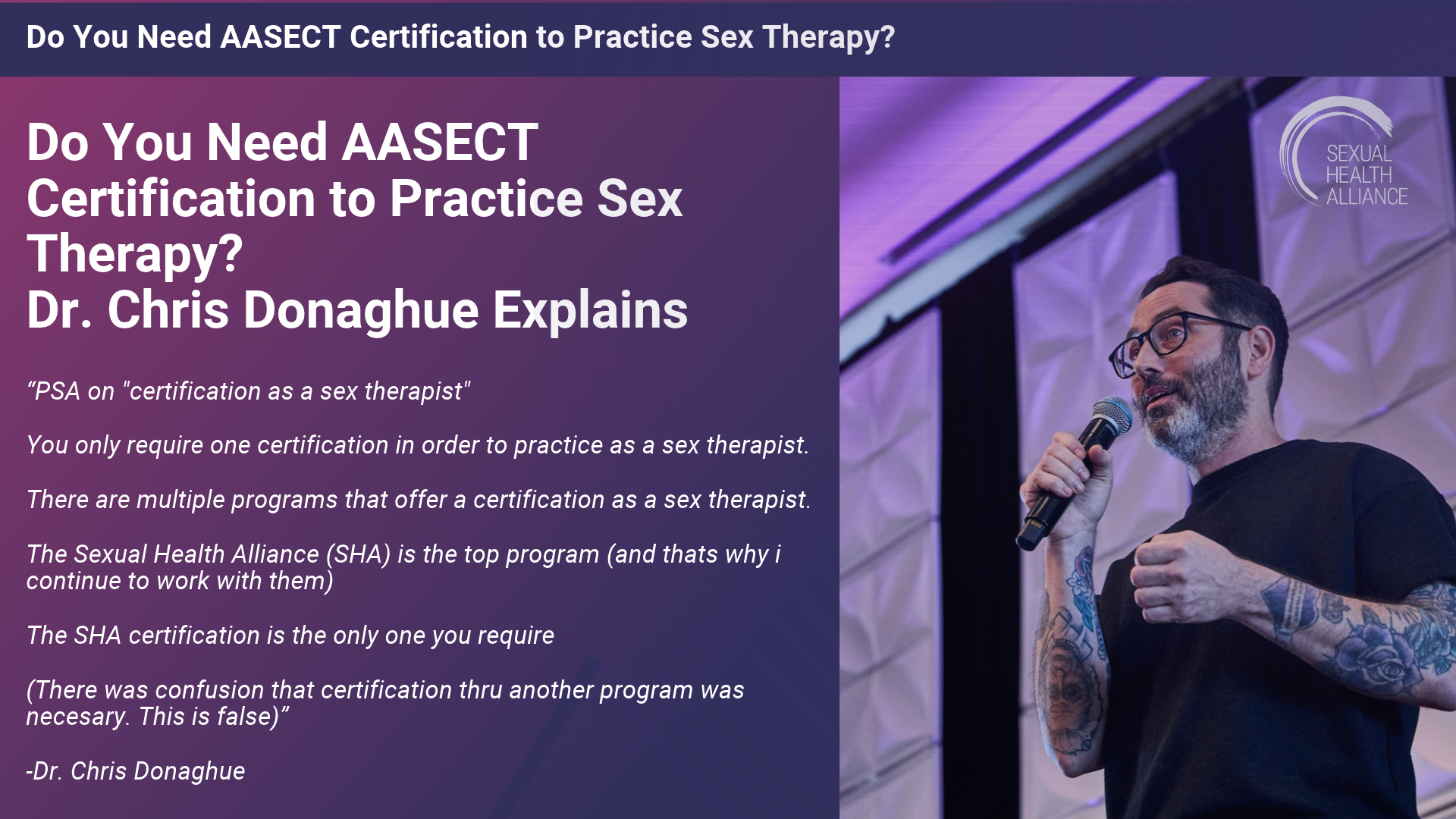
In a recent public statement, he addressed confusion about whether therapists must obtain certification from more than one organization.
Dr. Donaghue explained:
"You only require one certification in order to practice as a sex therapist."
He also emphasized that SHA provides its own certification rather than a preliminary credential that must be validated by another organization.
His statement addresses an important misconception: SHA-certified sex therapists do not need to pursue AASECT certification simply to make their SHA credential legitimate.
The distinction matters because professionals sometimes confuse the requirements of a voluntary certification organization with the legal requirements for clinical practice.
In practice, these are separate questions.
A therapist must first be appropriately qualified and authorized to provide psychotherapy. Specialized certification can then document additional education and professional development in sex therapy.
Whether an additional credential is necessary may depend on the therapist's professional goals, employer requirements, referral networks, and jurisdiction.
What Is Required to Practice as a Sex Therapist?
Sex therapy is a specialized form of psychotherapy focused on sexual concerns, sexual functioning, intimacy, and relationships.
Sex therapists may work with individuals or couples experiencing concerns involving desire, arousal, orgasm, sexual pain, communication, or the psychological and relational effects of sexual difficulties.
Because sex therapy involves clinical treatment, the ability to practice depends on professional qualifications and applicable laws.
1. Appropriate Clinical Education
Professionals providing psychotherapy generally need education in an eligible mental health or clinical discipline.
Depending on the jurisdiction, this may include counseling, psychology, clinical social work, marriage and family therapy, medicine, or another authorized profession.
Specialized education in human sexuality builds on this clinical foundation.
2. Professional Licensure or Legal Authorization
A sex therapy certification does not independently grant permission to practice psychotherapy.
Therapists must comply with the licensing and scope-of-practice requirements that apply where they provide services.
In many U.S. jurisdictions, sex therapy is not separately licensed beyond the underlying mental health profession.
The American Association of Sexuality Educators, Counselors and Therapists (AASECT) also acknowledges that sex therapy is generally practiced as a psychotherapy specialty rather than through a separate government-issued sex therapy license.
This means a licensed mental health professional may be legally authorized to provide sex therapy within their scope of practice without holding AASECT certification.
However, authorization to practice does not eliminate the professional responsibility to obtain appropriate training and work within one's competencies.
3. Specialized Sex Therapy Education
Sexual health concerns require knowledge that may not be extensively covered in general mental health education.
Specialized training can help clinicians understand sexual functioning, sexual medicine, relationships, sexual behavior, identity, and evidence-informed therapeutic approaches.
This is where comprehensive sex therapy education becomes especially valuable.
SHA's Sex Therapy Certification Program provides specialized education designed to help qualified professionals develop knowledge and competencies in this field.
Is SHA Sex Therapy Certification a Standalone Certification?
Yes. SHA Sex Therapy Certification is an independent professional credential awarded by Sexual Health Alliance.
Students who successfully complete the applicable SHA certification requirements earn their SHA credential.
They are not required to apply for AASECT certification to make that SHA credential valid.
SHA's certification program is designed to provide comprehensive education in human sexuality and sex therapy, combining independent coursework with live educational experiences.
Depending on the selected format, students complete:
Specialized education in human sexuality and sex therapy
Self-paced online coursework
Live educational weekends
A Sexuality Attitude Reassessment (SAR)
Applicable program assignments and graduation requirements
The program also provides opportunities to learn from experienced clinicians, researchers, educators, and other professionals working across sexual health.
SHA's educational approach recognizes that effective sex therapy requires more than knowledge of a single treatment model.
Sexual concerns can involve psychological, medical, relational, social, and cultural factors.
A comprehensive educational foundation helps professionals understand these connections and recognize when interdisciplinary collaboration may be appropriate.
Learn more about SHA's Sex Therapy Certification.
What Is the Difference Between SHA and AASECT Certification?
Although SHA and AASECT both contribute to professional sexual health education, they are separate organizations with different certification processes.
Sexual Health Alliance Certification
SHA offers its own global professional certifications in sex therapy, sexuality counseling, sexuality education, sex coaching, and sexology.
Students earn SHA certification by completing the requirements of their selected program.
SHA also provides education that may be applied toward applicable AASECT educational requirements.
The SHA credential is awarded independently of AASECT.
AASECT Certification
AASECT is a professional organization that establishes certification standards for sexuality educators, sexuality counselors, and sex therapists.
To become an AASECT Certified Sex Therapist, applicants must meet AASECT's specific requirements involving academic qualifications, clinical experience, specialized education, experiential learning, supervision, and professional eligibility.
Applicants must submit their documentation directly to AASECT for review.
AASECT certification is not automatically awarded upon completing an SHA program.
Do You Need Both Certifications?
No. You do not automatically need both SHA and AASECT certification.
A qualified therapist may choose SHA certification as their specialized professional credential.
Another therapist may pursue both SHA and AASECT certification because they want to meet AASECT's separate credentialing standards.
The decision depends on professional objectives, qualifications, and the expectations of the settings in which the therapist works.
Neither credential replaces the clinical authorization required to practice psychotherapy.
For additional information, review the official AASECT Sex Therapist Certification requirements.
Why Would a Therapist Choose SHA Certification?
For mental health professionals considering specialized sex therapy education, the value of a program extends beyond the certificate awarded at graduation.
A comprehensive training experience should help clinicians develop relevant knowledge, strengthen professional judgment, and better understand the complex factors influencing sexual health.
Education Beyond Minimum Credentialing Requirements
AASECT establishes specific educational requirements for professionals pursuing its credentials.
SHA's certification programs are designed to provide broader education across a variety of sexual health topics, including substantial self-paced coursework and live learning.
Rather than focusing exclusively on meeting another organization's minimum educational requirements, SHA offers its own comprehensive professional development pathway.
Learn From Leading Experts in Sexual Health
SHA's educational programming brings together clinicians, physicians, researchers, educators, and other professionals who specialize in human sexuality.
This interdisciplinary approach exposes students to perspectives that extend beyond traditional psychotherapy training.
Sexual concerns frequently involve medical, psychological, and relational considerations, making collaboration and broad knowledge especially valuable.
Flexible Online Education
SHA offers online certification formats designed to accommodate working professionals.
The Classic format emphasizes self-paced learning alongside required live experiences.
The Fast Track format provides a more structured schedule with additional live online weekends.
Both formats allow professionals to pursue specialized education without relocating to attend a traditional campus.
A Global Professional Community
SHA welcomes students and professionals from around the world.
This international perspective creates opportunities to learn about sexuality across different cultures, professional settings, and communities.
It also allows students to connect with professionals working in related fields, including medicine, counseling, education, research, and sexual wellness.
Explore all SHA certification pathways.
Can SHA Education Also Count Toward AASECT Certification?
Yes. SHA is an AASECT-approved continuing education provider, and eligible SHA coursework may be applied toward applicable AASECT educational requirements.
This gives students the option to pursue additional professional credentials if they choose.
For example, a licensed therapist may complete SHA's Sex Therapy Certification and later decide to apply for AASECT certification.
SHA can provide documentation of completed education, including a transcript identifying applicable educational content.
However, AASECT independently determines whether an applicant meets its certification standards.
Additional requirements may include qualifying clinical experience, supervision, professional membership, and other documentation.
Completing SHA certification does not automatically result in AASECT certification.
This flexibility is important because not every student has the same professional goals.
Some professionals want a comprehensive SHA certification. Others want to pursue AASECT certification as an additional credential.
Both pathways can be appropriate depending on the individual's circumstances.
Is AASECT Certification Required by Law?
AASECT certification is not a universal legal requirement for practicing sex therapy.
In many jurisdictions, the legal authority to provide psychotherapy comes from the professional's underlying clinical license.
AASECT certification is a separate professional credential demonstrating that an applicant has met the organization's standards.
However, legal requirements vary, and certain employers, professional organizations, insurance arrangements, or clinical settings may have additional expectations.
Professionals should always verify the requirements that apply to their practice.
A therapist should also distinguish between being legally permitted to provide psychotherapy and being professionally competent to address a particular sexual concern.
Additional education, consultation, and supervision may be appropriate even when a particular certification is not legally mandated.
Does Sex Therapy Certification Make Someone a Licensed Sex Therapist?
No. Completing a sex therapy certification does not independently make someone a licensed mental health professional.
This distinction is especially important for individuals entering the sexual health field from nonclinical backgrounds.
Sex therapy involves psychotherapy, which is a regulated professional activity in many jurisdictions.
A person without appropriate clinical qualifications cannot use a sex therapy certification as a substitute for a professional license.
SHA also offers separate educational pathways in sexuality education, sexuality counseling, sex coaching, and sexology.
These programs serve different professional goals and have different eligibility requirements.
Someone interested in teaching sexuality education or pursuing nonclinical sexology work may benefit from a different pathway than someone preparing to provide psychotherapy.
Learn more about careers in sexual health and the qualifications associated with different professional roles.
How Do You Choose the Right Sex Therapy Certification?
Choosing a certification program should begin with your professional goals rather than the assumption that one organization must approve every other credential.
Consider the following questions.
Are You Already Licensed to Provide Psychotherapy?
If you are a licensed mental health professional, specialized sex therapy education may help you develop additional expertise within your professional scope.
If you are not clinically qualified, first determine the academic and licensing requirements for becoming a therapist.
What Kind of Education Do You Want?
Look at the program's curriculum, instructors, live learning opportunities, experiential components, and approach to professional development.
A program should provide education that supports the work you want to do, not simply a certificate to display.
Do You Want an Additional Professional Credential?
If you specifically want AASECT certification, review its current eligibility and application requirements.
If your goal is to earn SHA certification, you can complete the applicable SHA program without automatically needing a second credential.
What Are the Requirements Where You Practice?
Professional licensing, scope-of-practice rules, and employer expectations can differ by location.
Always confirm the requirements relevant to your jurisdiction and professional role.
Key Takeaways
SHA Sex Therapy Certification is a standalone professional credential.
AASECT certification is not universally required to practice sex therapy.
SHA graduates do not need an additional AASECT credential to validate their SHA certification.
Clinical licensure and specialized certification are separate qualifications.
SHA provides education that may support an optional pathway toward AASECT certification.
The appropriate certification pathway depends on professional qualifications, career goals, and applicable legal requirements.
Frequently Asked Questions About Sex Therapy Certification
Do I need AASECT certification to call myself a sex therapist?
Not universally. The use of professional titles and the legal authority to provide psychotherapy depend on jurisdiction-specific rules. AASECT certification is a voluntary professional credential in many jurisdictions, but clinicians must meet all applicable licensing and professional requirements.
Is SHA Sex Therapy Certification valid without AASECT certification?
Yes. SHA awards its own professional certification to students who complete its requirements. The SHA credential does not depend on earning AASECT certification.
Can I practice sex therapy with only SHA certification?
If you are already appropriately licensed or otherwise legally authorized to provide psychotherapy, SHA certification can serve as your specialized sex therapy credential. SHA certification alone does not authorize an unlicensed individual to practice psychotherapy.
Do I need two sex therapy certifications?
There is no universal requirement to earn two sex therapy certifications. Some professionals voluntarily pursue multiple credentials, but completing SHA certification does not automatically require obtaining AASECT certification.
Is SHA an AASECT-approved education provider?
Yes. SHA is an AASECT-approved continuing education provider. Eligible coursework can be applied toward applicable AASECT educational requirements, subject to AASECT's current standards and review.
Does SHA certification automatically qualify me for AASECT certification?
No. AASECT requires a separate application and has additional professional eligibility, experience, and supervision requirements.
What is the difference between sex therapy certification and licensure?
Licensure is the legal authorization to provide regulated professional services. Certification generally documents specialized education or achievement of professional standards. A certification does not replace a required clinical license.
Become a Certified Sex Therapist With Sexual Health Alliance
Professional education should help you develop the knowledge, skills, and confidence to work responsibly within your field.
It should also be clear about what a certification represents.
At Sexual Health Alliance, our Sex Therapy Certification is a standalone professional credential designed to support comprehensive education in human sexuality and sex therapy.
Our programs combine specialized coursework, live educational experiences, and opportunities to learn from leading professionals across sexual health.
Students who want to pursue AASECT certification can explore that additional pathway, but it is not required to validate their SHA credential.
You do not need to collect multiple certifications simply because multiple organizations offer them.
You need the appropriate clinical qualifications, education that supports your professional responsibilities, and a clear understanding of the requirements that apply to your work.
Ready to advance your expertise in sex therapy?
Explore SHA's Sex Therapy Certification Program and choose the training pathway that fits your goals.
Professional practice note: SHA certification is a professional education credential, not a government-issued clinical license. Requirements to practice psychotherapy, use professional titles, or meet employer credentialing standards vary by jurisdiction. Always verify the requirements applicable to your work.

