

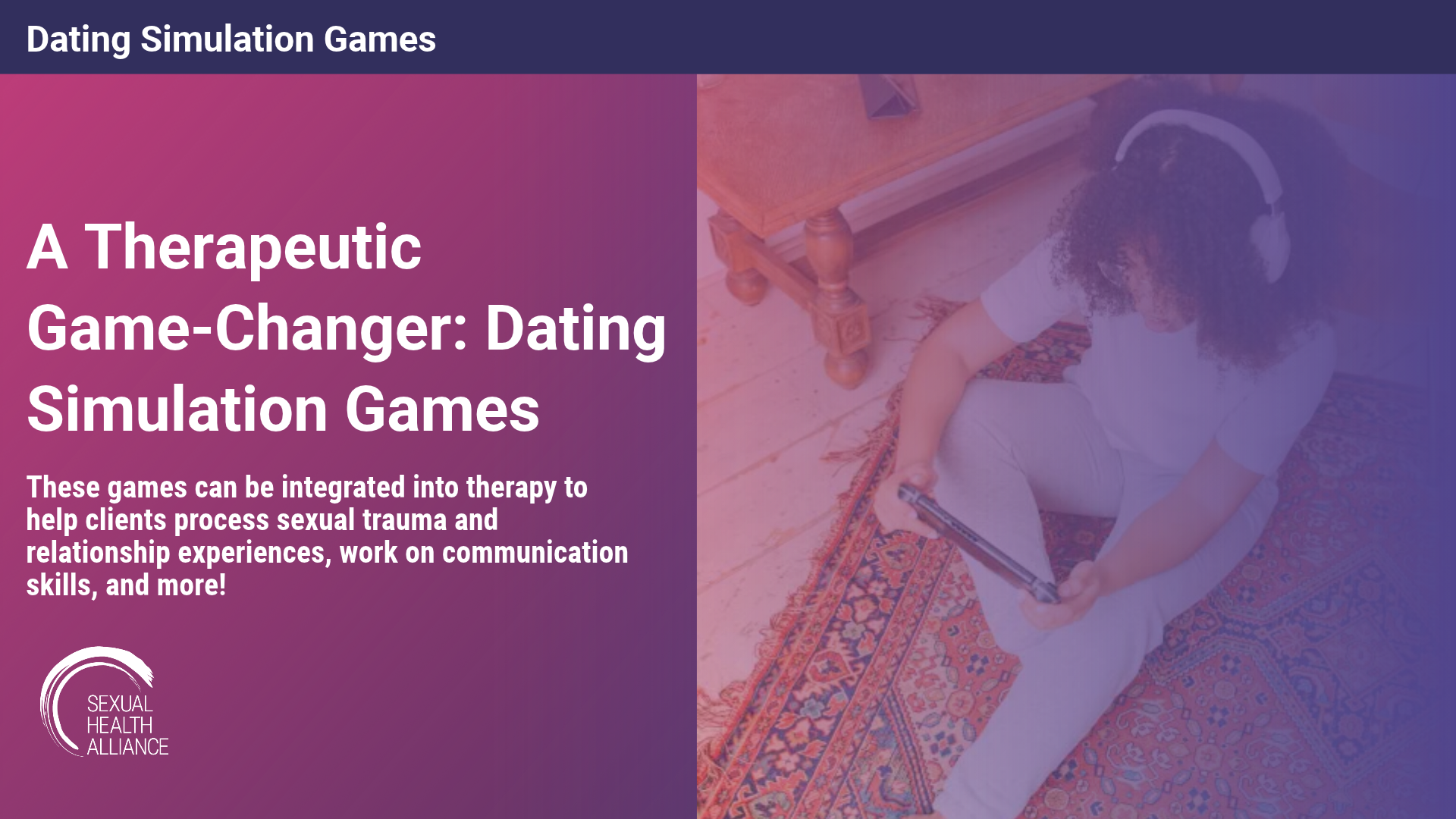
In the age of constantly improving technology, mental health and sexual health professionals would be remiss not to consider new tools and approaches. These days we have apps, websites, and other technological tools. Some professionals, like Laura Wood, LMHC, NCC, CST, even use video games as a catalyst to therapeutic interventions.
I had the opportunity to speak with Laura who not only is an adjunct professor at Seattle University and a SHA presenter, but also has a great deal of expertise working with individuals who fall into the intersection of neurodivergence and trauma history. This blog pinpoints some of the highlights from our conversation. If you’re interested in listening to the full interview, you can take a look at the Sexual Health Alliance YouTube Channel.
What are Dating Simulation Games?
Dating simulation games are a type of game, typically a video game, in which players learn how to date and have relationships. In these games, players are having relational interactions and navigating interactions in dating situations.
Although there are many different dating simulation games, here are just a few examples:
Monster Prom
Date Everything
Coffee Talk
Dating simulation games can range in how realistic they are. Some are fantasy-based while others mimic the real world. They also vary in duration and replayability.
How Can Dating Simulation Games Be Used in Therapy?
I want to start by pointing out that using games in therapy is not new. Play therapy for children has been around for over a hundred years, and therapists who see adults can stand to learn a thing or two from it. After all, there is no mandate that therapy always needs to be serious and intense!
Sessions can include dating simulation games as a conduit for intervention, as a form of exposure, or both. Laura described that she will have her clients play on a handheld game console while she follows along on her own device. The client will describe the moves they make when they get to a relational part of the game. Then, Laura might inquire about how the client feels in response to that situation or choice. These questions do not sound too different from the therapy many of us are familiar with:
What feelings did that bring up for you?
Tell me about what sensations you have in your body right now.
What thoughts came up when you were trying to decide how to move forward?
At this point, something pivotal might come up. Maybe the client opens up about their difficulties dating in the past or discloses a history of sexual trauma. Laura notes that at this point, she would draw from her more traditional therapy training, whether that be CBT, EMDR, or narrative therapy.
Dating simulation games can also be incredibly helpful because they allow the therapist to be less directive. In some ways, they can even tip the power imbalance that is inherent in the therapeutic relationship a little closer towards leveled.
Who Could Benefit from Dating Simulation Games in Therapy?
It seems to me that the list of people who would not benefit from dating simulation games may be shorter than those that would!
In general, this question seems context dependent. In Laura’s experience, her femme clients tend to really resonate with dating simulation games in therapy. This is possibly because many of the dating simulation games are not super life-like which takes away the pressure to perform, or because the games offer more agency and control than the clients may feel in their real lives.
This is not just exclusive to femmes though! Many people could benefit from dating simulation games as a catalyst to therapeutic intervention.
How Can You Implement Dating Simulation Games in Therapy?
There are a range of different applications and uses for dating simulation games in therapeutic settings. Here are a few examples:
Conduit to disclosure. Talking about past dating experiences, relational or sexual trauma histories and sexual health concerns can be difficult. Clients may have never disclosed that information, or even if they have, it can still be a point of vulnerability. Weaving a dating simulation game in the session sets the stage to have those hard conversations and begin to process those experiences.
Exposure is commonly used in therapy as a pathway for clients to habituate to stimuli that cause them anxiety, stress, or discomfort. For people who have anxiety about dating, dating simulation games can help them try it out without all the associated risks. With that in mind, these games could serve as one of the first steps in an exposure ladder. Clients can stop at any time, and have their therapist in the room to help them along the way.
Social skills training is another reason why dating simulation games may be helpful for clients. The dating world is complicated, full of small subliminal messages and subtext that can be difficult to pick apart, especially if the client identifies as neurodivergent. Dating simulation games can be an introduction into the nuances of real-world relationships and help the client build effective relational communication skills.
What do Mental Health Professionals Need to Know Before Integrating Dating Simulation Games Into Their Practice?
Play through it as a person. Laura recommends that if you want to use a dating simulation game in your therapy practice, you should play it first as a human. This means noting what feelings and thoughts come up as you navigate the game. This can help you understand your clients’ feelings when they play through it.
Do it again as a therapist. Afterwards, you should play it again with your therapist hat on. Note decision points and what questions you may want to ask at those times. It is important to have a road map so you are not caught off guard. The last thing you want is for the client to hit a potentially triggering decision point just as the session is meant to be winding down. You also need to be knowledgeable enough about the game to offer forewarnings when appropriate.
Want to become an in-demand sexual health professional? Learn more about becoming certified with SHA!
Written by Jesse John, B.S.
Jesse is a clinical psychology doctoral student at Rowan University in New Jersey. Their research focuses on sexual decision-making, sexual violence, and relationship experiences. The author identifies as a Queer, neurodivergent, non-binary, white person, which informs the way they write and see the world!

